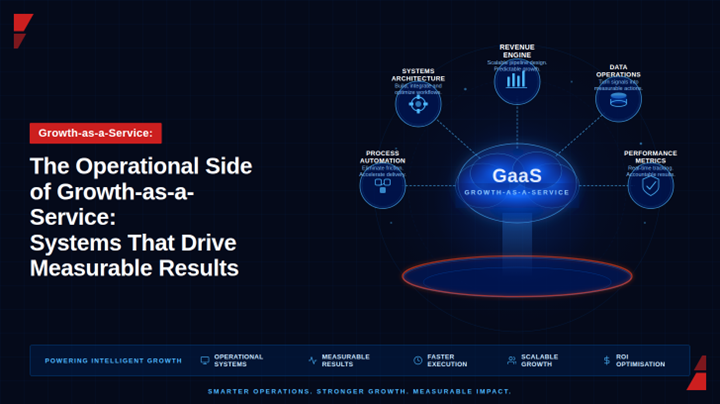
Growth is often described as a strategy problem. In practice, it is usually an operations problem. A business can have sharp positioning, strong creative, and a capable sales team, yet still stall because execution is inconsistent.
That is where Growth-as-a-Service becomes distinct. It is not just outsourced marketing support – it is a structured operating layer built to turn experiments, channels, and customer signals into repeatable commercial movement. In a market where speed matters more than polish, the teams that win are usually the ones that can connect planning, execution, and measurement without losing momentum.
What Makes Growth-as-a-Service Operationally Different?
The real difference is not effort – it is architecture.
Traditional agencies often work in bursts – a campaign launches, results are reviewed, and the next brief starts from scratch.
Growth-as-a-Service behaves differently. It embeds a dedicated growth team inside the business rhythm, with clear cadence, shared dashboards, and ongoing optimization. It is closer to amarketing operations strategy than a campaign-retainer relationship.
A strong operating model changes the unit of work from “launch and move on” to “test, learn, refine, repeat.” That is the point at which Growth-as-a-Service becomes a system.
The 5 Critical Systems Behind Measurable Growth-as-a-Service Results
1. Data Infrastructure & Measurement System
No growth team can improve what it cannot see.
A reliable growth analytics framework starts with clean data flowing from CRM, analytics, attribution, and revenue systems into one view. That means tracking CAC, LTV, churn, conversion rate, and ROI in a way the entire team can trust. Without that spine, decisions become debates.
The operational win here is simple:
- one source of truth for performance
- one naming convention for campaigns
- one reporting rhythm across teams
- one definition of what counts as a qualified result
That is what turns numbers into direction.
2. Experimentation & Testing Workflow
Measurable growth does not come from being right once. It comes from being wrong quickly and usefully.
A mature experimentation engine creates space for controlled testing across emails, ads, landing pages, offers, and onboarding flows. The goal is not endless tests. The goal is a disciplined feedback loop that helps the team identify what actually moves revenue.
This is where campaign performance optimizationbecomes a habit rather than a rescue tactic. Each test should answer a sharp question:
- Which message creates the strongest response?
- Which channel creates the best-quality lead?
- Which page element is causing drop-off?
- Which offer brings in buyers, not just clicks?
The current trend is clear – AI is being used more deeply inside marketing functions – but the organizations seeing the best results are the ones that pair speed with structure. McKinsey found that 65% of respondents said their organizations were regularly using gen AI in at least one business function, with marketing and sales among the most common areas. At the same time, Adobe reports that only 7% have embedded AI in ways that deliver measurable business results. Adoption is not the same as impact.
A strong experimentation workflow closes that gap.
3. Cross-Channel Execution Framework
Growth breaks down fast when channels operate like separate systems.
SEO, paid media, content, lifecycle email, and retention cannot run on disconnected logic. They need one brief, one message architecture, one segmentation model, and one coordination cadence. Otherwise, the business spends money to create confusion.
This is where many teams underestimate the value of Growth-as-a-Service. It does not just add hands. It aligns the moving parts.
A solid execution framework typically includes:
- Shared audience definitions
- Consistent creative and messaging rules
- Channel-level ownership with central coordination
- Budget shifts based on live performance
- Weekly prioritization based on revenue impact
Personalization makes this even more urgent. McKinsey reports that 71% of consumers expect personalized interactions, and 76% become frustrated when they do not get them. That makes channel alignment a commercial requirement, not a branding preference.
4. Automation & AI Integration Layer
Automation should reduce drag – not add noise.
In a healthy system, automation handles repetitive work – lead scoring, routing, segmentation, alerting, content variation, and reporting hygiene. AI then extends that layer by helping teams personalize at scale, surface patterns faster, and reduce manual bottlenecks. The best use of growth enablement systems is not novelty. It is a compression of wasted effort.
The latest direction in the market is toward workflow-native AI – not standalone tools. Adobe notes that more than 8 out of 10 marketing teams missed an opportunity last quarter because they could not respond in time – which is a signal that speed is now a structural issue. AI only matters when it shortens that response window in a controlled way.
Used properly, automation gives the team more room for judgment. It removes the mechanical parts so people can focus on decisions that require taste, context, and commercial instinct.
5. Reporting & Accountability Dashboard
A dashboard is not a reporting accessory. It is the operating contract.
When the right metrics are visible in real time, accountability becomes practical. Teams know what is working, what is lagging, and where to intervene. Leaders stop asking for status updates and start asking better questions.
This is one of the clearest ways to protect data-driven decision making. The dashboard should not drown people in activity metrics. It should tie work to business outcomes:
- Pipeline created
- Revenue influenced
- Cost per acquisition
- Retention lift
- Conversion by stage
- Speed to response
If the dashboard cannot explain business movement – it is decoration.
How Growth-as-a-Service Prevents Operational Chaos During Scaling?
Many businesses hit a familiar wall when demand rises faster than the system behind it.
The symptoms are easy to spot – unclear ownership, slow approvals, duplicated work, inconsistent messaging, and performance visibility that arrives too late to help. Growth efforts still exist – but they stop compounding.
Here, Growth-as-a-Service earns its value. It reduces chaos by creating structure before the pressure peaks. It documents processes, defines roles, sets decision rights, and embeds KPIs into the daily flow of work. That matters because even the smartest growth plan can fail if the people executing it do not have the resources, alignment, and shared ownership to carry it forward.
The result is a shift from effort-based growth to infrastructure-based growth. The business stops depending on heroics and starts relying on systems.
How to Evaluate a Growth-as-a-Service Provider’s Operational Maturity?
Before choosing a partner, look beyond the pitch deck. Ask whether they can show:
- A clear measurement architecture
- A testing cadence with documented learnings
- Channel coordination across the funnel
- Reporting tied to commercial outcomes
- Automation that removes manual friction
- A real operating rhythm – not just creative output
If a provider talks mainly about ideas but cannot explain how they track, test, and adapt, the model will stay shallow. A credible partner should be able to show how their process supports repeatable growth – not just temporary visibility.
Conclusion
The businesses that grow reliably are usually the ones that treat growth like an operating discipline. They measure carefully, test constantly, coordinate channels, and build feedback into every layer of execution. That is the real promise of Growth-as-a-Service – not more activity, but more control over how activity turns into outcomes. For companies ready to move beyond scattered tactics, connect with us for Growth-as-a-Service, a practical path to scale with clarity, speed, and accountability.