Most enterprise AI projects die in pilot mode.
According to recent industry benchmarks, over 80% of corporate artificial intelligence initiatives never reach full production deployment. Engineering teams spend months wrapping APIs around foundation models, building quick internal proofs-of-concept (PoCs), and presenting impressive demos to executive boards.
Then reality hits.
When scaled to thousands of concurrent users, token costs skyrocket. Hallucination rates render outputs risky for client-facing channels. Internal security teams block deployment over data privacy concerns. What looked like a breakthrough in a sandbox environment becomes an expensive, unmaintainable technical debt trap.
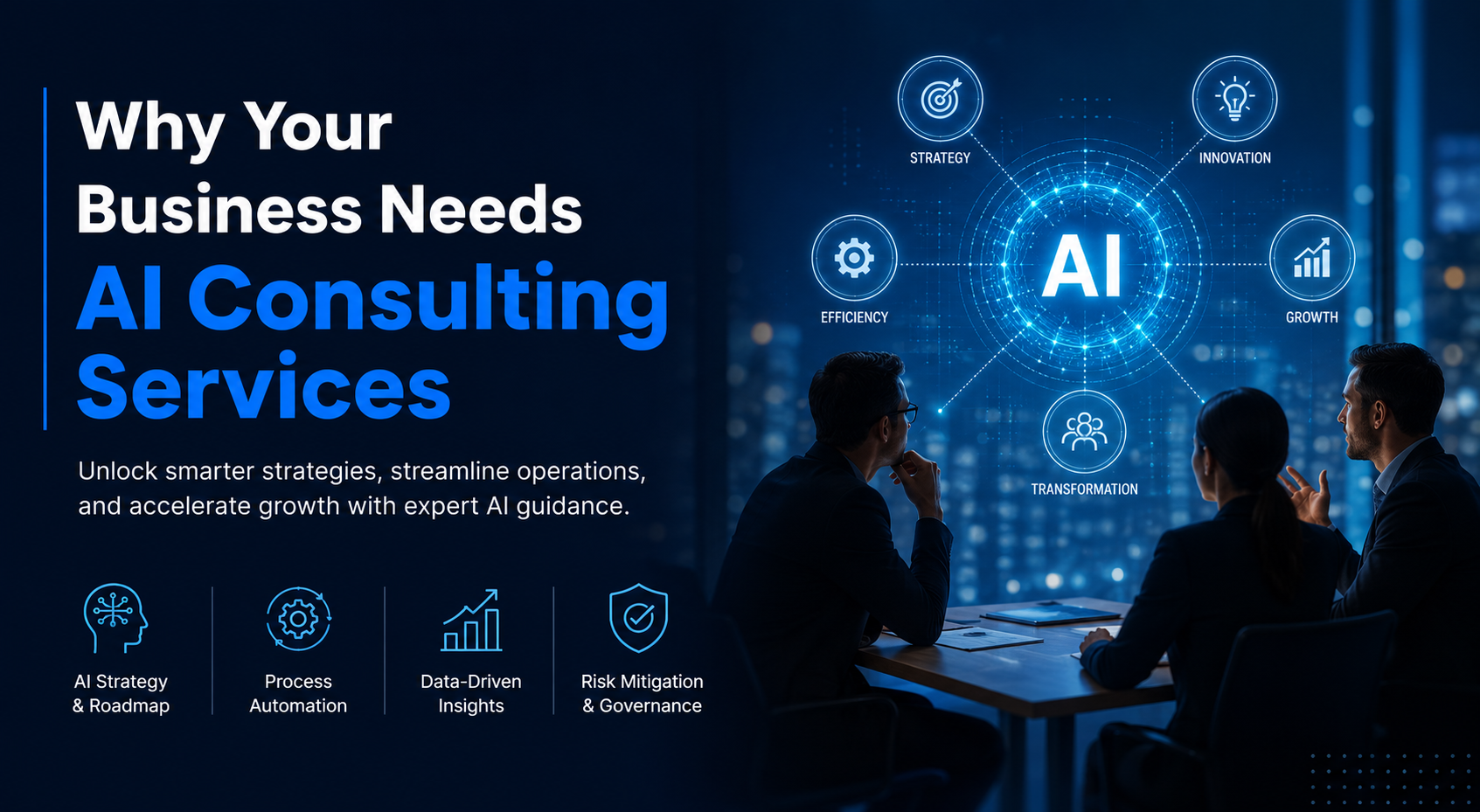
This failure rarely stems from weak engineering talent. It happens because deploying enterprise-grade artificial intelligence requires a structural strategy, rigorous compliance architecture, and disciplined ROI modeling. That is precisely why forward-thinking CTOs, CEOs, and product leaders rely on specialized AI Consulting Services to bridge the gap between pilot experiments and sustainable bottom-line growth.
The PoC Graveyard: Why In-House AI Initiatives Stall
Building a quick AI wrapper is easy; running a resilient, secure, and cost-effective AI engine inside an enterprise architecture is notoriously difficult. Internal product teams often lack the specific cross-disciplinary experience required to take models from benchmark tests into live production.
1. Misalignment Between Models and Business Outcomes
Engineers often pick models based on benchmark scores rather than operational economics. A 70-billion-parameter open-source model or top-tier commercial LLM might deliver incredible reasoning, but if your application requires sub-second latency for simple data extraction, you are over-provisioning infrastructure and burning capital. Strategic artificial intelligence consulting realigns tech stack selection with actual business metrics balancing unit economics, throughput, and accuracy requirements.
2. Uncontrolled Token Economics and Compute Sprawl
Without strict architecture patterns such as semantic caching, query routing, and fine-tuned smaller models API costs scale linearly or exponentially with user activity. Enterprise leaders routinely encounter “sticker shock” when a successful beta turns into a six-figure monthly computer bill.
3. The Shadow AI Security Vacuum
When corporate leadership does not provide clear guidelines and tools, internal teams create their own. Employees feed sensitive customer data, proprietary source code, and unreleased financial reports into consumer-grade public models. This creates immense legal, regulatory, and intellectual property liabilities that can paralyze a company once discovered.
Core Deliverables: What Specialized AI Consulting Services Provide
Engaging an external team is not about buying generic slides or high-level strategic buzzwords. High-value AI Consulting Services deliver concrete engineering roadmaps, governance frameworks, and measurable ROI models.
Architectural Precision and Model Orchestration
External experts bring battle-tested experience across dozens of deployments. Instead of defaulting to brute-force prompting, they design hybrid architectures that combine Retrieval-Augmented Generation (RAG), fine-tuned open-source models, and deterministic software logic.
- Latency & Throughput Optimization: Structuring caching layers to intercept repetitive queries before touching expensive model endpoints.
- Model Routing: Directing low-complexity tasks to light, low-cost models while reserving high-parameter models for complex reasoning.
- Data Lineage & RAG Pipelines: Building vector database infrastructure that cleans, chunks, and indexes corporate knowledge bases without hallucination drift.
Establishing Enterprise AI Governance Solutions
You cannot scale what you cannot control. Modern enterprise environments must comply with evolving international frameworks like the EU AI Act, alongside established standards such as SOC 2 Type II, HIPAA, and GDPR.
Deploying tailored ai governance services ensures your organization implements:
- Data Isolation: Guaranteeing proprietary inputs never train third-party foundation models.
- Auditability & Explainability: Creating logging systems that record model decisions, prompt inputs, and system outputs for regulatory audits.
- Red Teaming & Guardrails: Implementing automated guardrail layers (such as NeMo Guardrails or custom middleware) to block jailbreaking, prompt injections, and toxic outputs in real time.
By embedding comprehensive ai governance solutions early in the product roadmap, organizations protect brand reputation while accelerating compliance approvals from internal legal and security teams.
Bridging Strategy and Execution: AI Governance and Consulting
A common executive misconception is that governance slows down innovation. In practice, the opposite is true. Unclear boundaries create risk aversion, leading legal and compliance departments to veto promising initiatives late in the development cycle.
A dedicated framework combining AI Governance and Consulting provides developers with a clear “safe-sandbox” specification. When technical teams know exactly which datasets are approved, what token budgets exist, and how output validation is measured, development velocity increases.
Strategic Impact of Structured Governance
| Governance Pillar | Strategic Focus | Operational Business Outcome |
| IP & Model Ownership | Secures fine-tuned weights and proprietary vector indexes | Prevents vendor lock-in and protects enterprise value |
| Cost Control & Quotas | Implements automated rate-limiting and unit-cost tracking | Prevents runaway API and cloud compute expenses |
| Output Accuracy Assurance | Sets up automated evaluation benchmarks (e.g., Ragas, TruLens) | Keeps hallucination rates safely below operational thresholds |
| Data Privacy Guardrails | Enforces real-time PII masking and redaction pipelines | Guarantees compliance with global privacy regulations |
When Should Your Leadership Seek an AI Consultation?
Not every business challenge requires immediate external intervention. However, specific operational inflection points signal that internal teams need senior expert guidance.
Consider booking a focused ai consultation if your executive team faces any of the following scenarios:
- Stuck in Proof-of-Concept Stage: Your technical teams built impressive internal demos six months ago, but the project has failed to transition into a customer-facing or production-grade platform.
- Escalating Infrastructure Costs: Monthly model API usage or GPU cluster costs are growing faster than underlying product usage and revenue.
- Regulatory & Data Security Blockers: Your legal department has halted AI deployments due to uncertainties around data leakage, copyright risk, or industry-specific compliance standards.
- Build vs. Buy Uncertainty: Leadership is debating whether to license third-party enterprise tools, fine-tune open-source models, or construct proprietary internal architectures from scratch.
An objective, vendor-neutral advisory assessment eliminates internal bias and provides executive teams with a clear, data-backed execution path.
How C-Suite Leaders Should Evaluate an AI Advisory Partner
The market is saturated with agencies claiming expertise in artificial intelligence. To avoid low-value engagements, C-suite executives should vet prospective partners using three strict criteria:
1. Hands-On Engineering Track Record
Avoid firms that only deliver slide decks and generic market overviews. Demand case studies demonstrating real production deployments, custom RAG pipelines, and infrastructure optimizations backed by quantified performance metrics.
2. Deep Integration of Governance Frameworks
Strategic advisors must treat security and compliance as core architectural features, not afterthoughts. Ensure your partner brings specialized experience delivering ai governance services that satisfy enterprise risk officers.
3. Clear Focus on Unit Economics and ROI
A competent advisory firm establishes tangible key performance indicators (KPIs) before writing code measuring success in reduced customer support handling times, lowered compute cost-per-transaction, or net-new platform revenue generation.
Final Verdict: Moving From Hype to High-Yield Execution
Treating artificial intelligence as a speculative sandbox experiment is no longer viable for competitive enterprises. The organizations that win in this market transition will not be those that deploy models the fastest, but those that build scalable, secure, and financially disciplined AI infrastructure.
Investing in expert AI Consulting Services provides the strategic clarity, architectural rigor, and operational governance needed to move past expensive trial-and-error. By aligning model capabilities directly with enterprise strategy, executive teams convert technological potential into a defensible competitive advantage.