What is a Globe Valve?
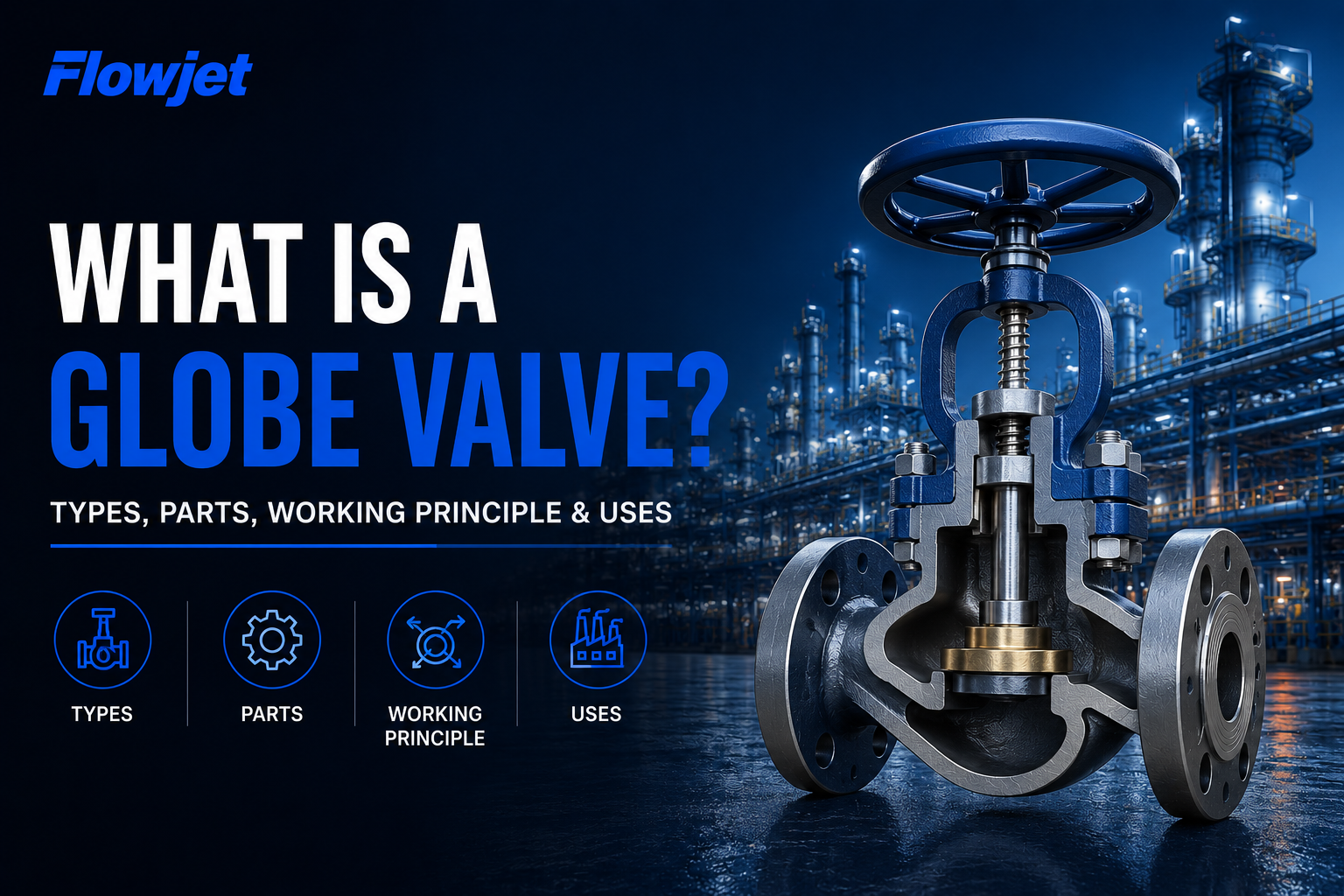
A globe valve is a type of linear motion valve used to regulate, start, or stop fluid flow in a pipeline. It features a movable disc (or plug) that sits against a stationary ring seat inside a spherical-shaped body—hence the name “globe” valve.
Unlike gate valves, which are designed for full open or full closed positions, globe valves are specifically engineered for throttling (flow regulation). The flow path changes direction inside the valve body—typically forming an S-shape — which provides precise flow control but adds some resistance (pressure drop) to the system.
As a trusted globe valve manufacturer, Flowjet Valve designs and manufactures high-performance globe valves for industries requiring accurate flow regulation, dependable shut-off capabilities, and long service life under demanding operating conditions.
Key Definition: A globe valve controls flow by moving a disc perpendicular to the flow direction, against a seat. This design enables fine regulation of flow rate, not just on/off control.
How Does a Globe Valve Work?
The working principle of a globe valve is straightforward:
● The handwheel (or actuator) turns the stem, which moves the disc up or down. ● When the disc moves DOWN, it presses against the seat — flow is stopped (closed position).
● When the disc moves UP, it lifts away from the seat — fluid flows through the gap (open position).
● By positioning the disc at varying heights above the seat, you control how much fluid passes through — this is throttling.
The fluid inside the valve changes direction twice as it flows through (entering from below the seat, passing through, and exiting at the side), which is why globe valves create a higher pressure drop than gate or ball valves. However, this very design is what gives them superior throttling control.
Parts of a Globe Valve
A standard globe valve consists of the following main components:
Part Function / Description
Body The outer spherical shell that contains all internal components and connects to the pipeline.
Bonnet The top cover that encloses the stem and packing. Can be bolted, threaded, or pressure-seal type.
Disc (Plug) The movable component that contacts the seat to stop flow. Types include flat, needle, and ball disc.
Seat Ring The stationary ring inside the body against which the disc seals to stop flow. Stem The vertical rod that transmits motion from the handwheel to the disc. Handwheel The manual operator used to open or close the valve by rotating.
Packing Sealing material around the stem that prevents fluid leakage to the atmosphere.
Gland Flange
Compresses the packing to maintain the stem seal.
Yoke The structural framework that supports the stem nut and handwheel.
Back Seat A secondary seat inside the bonnet that acts as an emergency seal when valve is fully open.
Types of Globe Valves
Globe valves are classified by body pattern, disc type, and construction method. Here are the main types:
1. By Body Pattern
Z-Pattern Globe Valve (Straight Pattern): The most common type. The stem and seat are perpendicular to the pipe. Flow takes a Z-shaped path inside the valve. Simple design, suitable for most general applications. Higher pressure drop.
Y-Pattern Globe Valve: The seat and stem are inclined at 45° to the pipeline. This reduces flow resistance compared to the Z-pattern. Ideal for high-pressure steam, gas, and clean fluid applications.
Angle Globe Valve: The inlet and outlet are at 90° to each other. Acts like both a globe valve and an elbow fitting. Reduces pipeline space requirements and eliminates one pipe bend.
2. By Disc (Plug) Type
Flat Disc Globe Valve: Standard disc type. Good for general throttling and shut-off duty.
Needle Globe Valve: Needle-shaped plug for very precise fine flow control. Used in instrumentation and metering applications.
Plug Disc Globe Valve: Tapered plug provides tight shut-off. Suitable for higher pressure applications.
Ball Disc Globe Valve: Spherical disc used for liquids with low differential pressure. Simple and economical.
3. By Construction
Forged Steel Globe Valve: Made from forged steel — stronger grain structure, suitable for high-pressure and high-temperature services.
Cast Steel Globe Valve: Made from cast steel — versatile and economical for standard industrial applications. Available in larger sizes.
Globe Valve vs Ball Valve vs Gate Valve
A common question in industrial piping: which valve should you use? Here’s a quick comparison:
Feature Globe Valve Ball Valve Gate Valve Primary Use Flow regulation / throttling On/Off control On/Off (full bore) Throttling Excellent Poor Poor Pressure Drop High Low Very Low Sealing Good Excellent Good Flow Direction One direction Any direction Any direction Operation Multi-turn Quarter turn Multi-turn Cost Moderate Low-Moderate Low-Moderate
Best For Steam, chemicals, throttling
Water, gas, quick shut-off Full open pipelines
Applications & Uses of Globe Valves
Globe valves are used across a wide range of industries wherever precise flow regulation, throttling, or reliable shut-off is required:
Oil & Gas Industry
● Control of crude oil, natural gas, and condensate flow in pipelines
● Wellhead control valves
● Gas injection systems
● Offshore platform piping
Power & Energy Plants
● Steam control and isolation in boilers
● Feedwater regulation in turbines
● Cooling water systems
● Drain and vent valves
Chemical & Petrochemical Industry
● Precise dosing and flow control of chemicals
● Corrosive fluid handling with appropriate materials (SS, Inconel)
● Reactor inlet/outlet control
Pharmaceutical & Food Processing
● Hygienic globe valves for sterile fluid control
● CIP (Clean-in-Place) systems
● Water for injection (WFI) lines
Water Treatment & HVAC
● Flow balancing in HVAC systems
● Pump bypass and recirculation lines
● Pressure control in water treatment plants
Globe Valve Materials & Pressure Ratings Choosing the right material depends on the fluid type, temperature, and pressure:
Material Common Class / Rating
Typical Application
Carbon Steel (A216 WCB) ANSI Class 150–2500 Oil, gas, general steam
Stainless Steel (CF8M / CF3M)
ANSI Class 150–1500 Corrosive chemicals, food, pharma
Forged Steel (ASTM A105) Class 800 / 1500 / 2500 High-pressure, high-temp steam Alloy Steel (WC6, WC9) ANSI Class 300–2500 High-temp power plant services Ductile Iron PN 10–40 Water, HVAC, low-pressure utility
How to Select the Right Globe Valve
Follow these steps when specifying a globe valve for your application:
1. Define the service: What fluid? (liquid, gas, steam, slurry) What temperature and pressure?
2. Choose body pattern: Z-pattern for standard use; Y-pattern for low pressure drop; Angle for compact installation.
3. Select disc type: Needle disc for fine throttling; Flat disc for general throttling; Plug disc for tight shut-off.
4. Choose material: Carbon steel for oil/gas; Stainless steel for corrosive or sanitary services; Forged steel for high-pressure.
5. End connections: Flanged (most common for pipe), Butt-weld (permanent, high-pressure), Screwed (small bore, low pressure).
6. Choose actuation: Manual handwheel for infrequent operation; Electric actuator for remote or automated control; Pneumatic for fast response.
7. Check standards: Ensure valve meets API 600, API 602, BS 1873, or ASME B16.34 as applicable to your project specification.
Pro Tip: For steam and high-temperature service above 300°C, always specify forged steel globe valves with pressure-seal bonnets for maximum safety and reliability.
Frequently Asked Questions (FAQ)
What is the main purpose of a globe valve?
The main purpose of a globe valve is to regulate or throttle fluid flow in a pipeline. Unlike gate valves, globe valves can precisely control the flow rate by adjusting the position of the disc, making them ideal for applications requiring variable flow control rather than simple on/off switching.
Why is it called a globe valve?
A globe valve gets its name from the original spherical (globe-shaped) body design of early models. While modern globe valve bodies may not always appear perfectly spherical, the name has remained standard in the industry.
What is the difference between a globe valve and a gate valve?
A globe valve is designed for throttling (flow regulation) and provides a higher pressure drop. A gate valve is designed for full open or full closed operation with minimal pressure drop and should not be used for throttling as it causes disc and seat erosion.
Can globe valves be used for shut-off service?
Yes, globe valves provide good shut-off performance. However, they are not as tight as ball valves for zero-leakage shut-off. For critical tight shut-off applications, specify a globe valve with a hardened seat and plug disc.
What is the pressure drop in a globe valve?
Globe valves have significantly higher pressure drop than gate or ball valves due to the change in flow direction inside the body. This is an inherent trade-off for their excellent throttling capability. Y-pattern globe valves reduce this pressure drop compared to Z-pattern designs.
What standards apply to globe valves?
Common standards include: API 600 (cast steel), API 602 (forged steel, small bore), BS 1873 (steel globe valves for petroleum), ASME B16.34 (pressure-temperature ratings), and MSS SP-80 (bronze globe valves).
Conclusion
Globe valves are one of the most versatile and widely used valve types in industrial piping. Their ability to precisely throttle flow, combined with reliable shut-off performance, makes them indispensable in steam, oil & gas, chemical, pharmaceutical, and power applications.
When selecting a globe valve, consider the fluid type, operating conditions, required flow control precision, and applicable standards. Choosing the right body pattern, disc type, and material ensures long service life and reliable performance.
Looking for globe valves for your application? Flowjet Valves Pvt. Ltd. manufactures forged and cast steel globe valves certified to API, BS, and ASME standards. Contact us for a free quote — serving 800+ clients across India and globally.