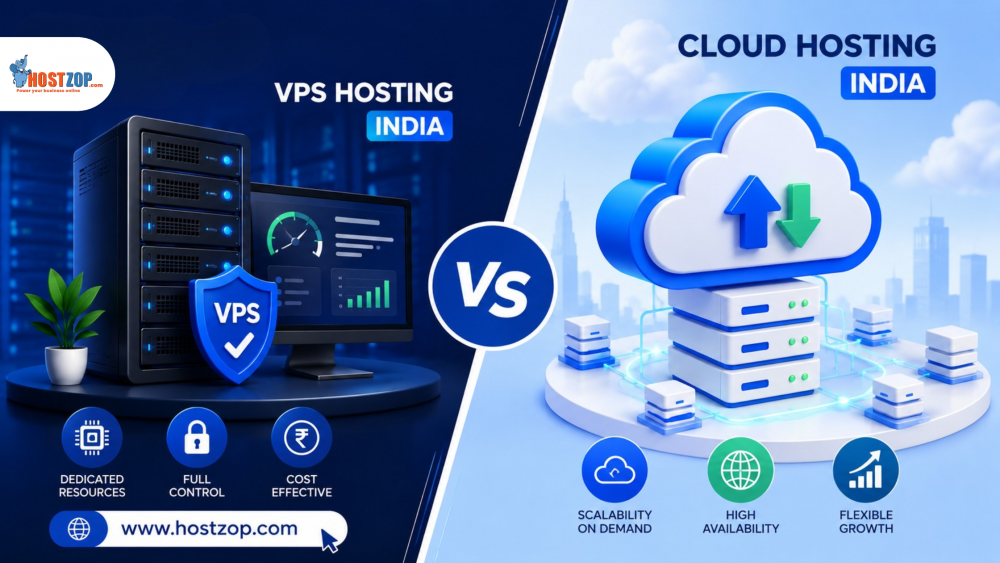
India’s digital infrastructure economy is maturing rapidly. Startups are growing on a scale that’s beyond the surface and ecommerce brands are getting deeper with their expansion, SaaS ecosystems are getting more intense, and creators are creating traffic-rich platforms that require more than just surface-level hosting. Here, the decision between vps hosting india and cloud hosting india hangs as a sword of Damocles.
The difference seems obvious at a cursory glance. The comparison between VPS and cloud hosting can be seen as cheap and managed versus elastic and futuristic, respectively. But behind these pretty stories are a lot of hidden costs, technical limits, and operational how-to’s that only a handful of businesses find out after they have deployed.
By 2026, selecting the right infrastructure isn’t just a convenience anymore, it’s a silent threat to profitability, scalability and performance.
Understanding The Fundamental Difference
The Virtual Private Servers (VPS) Hosting solution divides the physical servers into individualized spaces, offering the consumers their own portions of computing power at reasonably predictable costs. Particularly beneficial for small to medium sized businesses, agencies, bloggers, startups, etc., where budget planning is necessary.
In contrast, Cloud Hosting solution distributes the computing load among several geographically dispersed clusters of physical servers.
This sounds ideal. Often, it is. But “scalable” does not always mean “cost-efficient.”
The real distinction lies not in marketing language, but in operational economics.
Hidden Cost 1: Predictability Vs Consumption
One of the most underestimated advantages of VPS Hosting India is billing stability.
With VPS, businesses usually pay fixed monthly fees. CPU, RAM, storage, and bandwidth are often allocated within a clearer pricing framework. This predictability allows easier forecasting.
Cloud hosting introduces a different paradigm:
A startup experiencing sudden traffic success may celebrate growth until cloud invoices arrive with alarming exuberance.
For many users, cloud hosting India becomes deceptively expensive because flexibility can mutate into financial volatility.
Hidden Cost 2: “Unlimited” Bandwidth Myths
Both VPS and cloud providers frequently use seductive language:
● Enterprise-grade flexibility
Yet these terms often conceal nuanced limitations.
With cheap vps india, bandwidth may be “unmetered” but restricted by:
- Port speed
- Fair usage clauses
- Burst caps
- Shared uplink congestion
Meanwhile, cloud hosting often monetizes outbound traffic aggressively. Egress fees, CDN integration costs, and API-heavy architecture can quietly amplify expenditure.
This means that for media platforms, SEO-heavy sites, or ecommerce operations, headline affordability can be profoundly misleading.
Hidden Cost 3: Scalability Isn’t Always Practical
Cloud hosting’s greatest selling point is elasticity. In theory, businesses scale infinitely.
In practice, however:
● Autoscaling can increase costs exponentially
● Architecture complexity rises
● DevOps dependency intensifies
● Resource sprawl becomes harder to control
For many small and mid-sized businesses in India, a well-configured vps India cheap environment may actually provide better operational simplicity than over-engineered cloud ecosystems.
Not every website needs hyperscale architecture. Sometimes, practical efficiency outperforms aspirational complexity.
VPS Server Pricing: Cheap Can Be Strategic Or Dangerous
The phrase VPS Server Pricing often triggers budget-first thinking. But low-cost plans are not universally prudent.
Ultra-cheap VPS plans can compromise:
- SSD quality
- Uptime consistency
- Support response
- Security layers
- Virtualization overhead
This creates a paradox:
Lower upfront expense and increased operating expenses.
While searching for low cost vps hosting india, you should make sure that you take into account:
Renewal fees + backup fees + freedom to migrate + performance limits
Platforms like Hostzop often emphasize that true hosting value is rarely defined by entry price alone.
Cloud Hosting India: The Premium Trap
The rise of best cloud hosting in india discussions has created an aura of superiority around cloud ecosystems. And for certain use cases AI workloads, distributed SaaS, enterprise redundancy cloud can indeed be transformative.
But premium does not always equal necessity.
Many businesses overpay for:
If a business primarily runs:
- WordPress
- Local ecommerce
- Agency websites
- Moderate SaaS tools
…then cloud infrastructure may become a technological sledgehammer for a relatively simple operational nail.
Compliance, Latency & Geography
India’s infrastructure evolution in 2026 is increasingly shaped by:
This makes both vps hosting india and Cloud Hosting India more than pricing decisions they are strategic geography choices.
A Mumbai VPS may outperform an overseas cloud setup for local SEO and customer speed.
A Chennai cloud cluster may offer stronger southern regional responsiveness.
Location now influences not just speed but business credibility.
Who Should Choose What?
VPS May Be Better For:
Cloud May Be Better For:
The key is alignment not aspiration.
Final Thoughts: Affordable, Scalable Or Strategic?
Hosting in 2026 is not just about being cheaper or technologically superior it is about finding a balance between the two.
It is about:
● Predictability vs volatility
● Practical scaling vs infinite scaling
● Controlled cost vs elastic billing
For many businesses, cheap vps india may offer more real-world profitability than cloud. For others, best cloud hosting in India may unlock transformational growth.
But the wisest infrastructure decisions are not made by chasing buzzwords.
They are made by understanding hidden costs before they become expensive realities.
Because in the evolving contest of vps hosting india vs cloud hosting India, the winner is rarely the platform with the loudest promise.
It is the one with the fewest financial surprises.