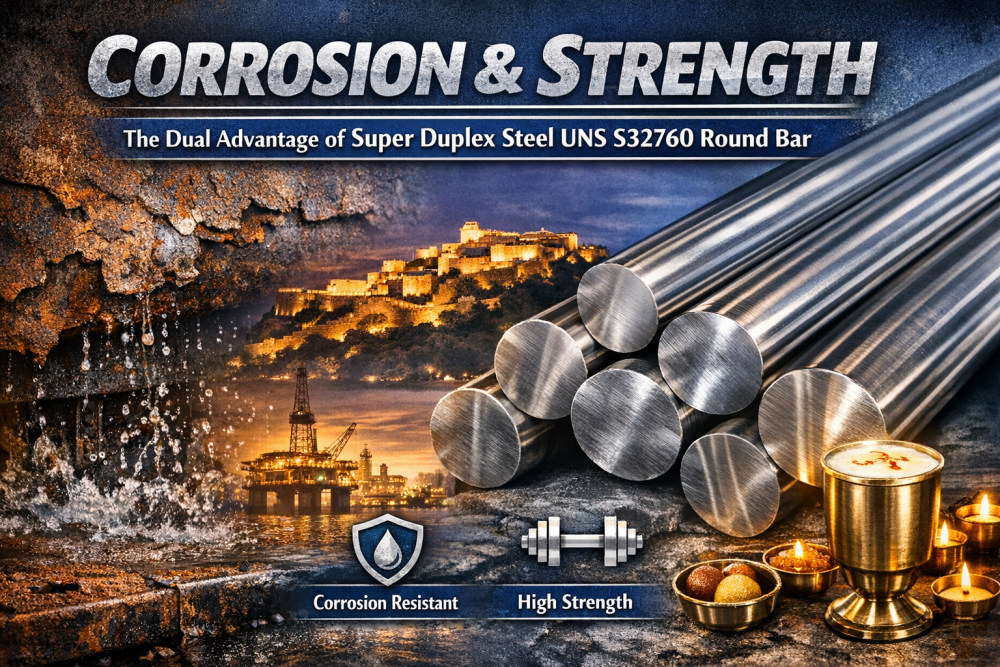
UNS S32760 super duplex stainless steel has become a go-to material for some of the world’s most demanding offshore applications because it offers both high mechanical strength and exceptional corrosion resistance. In offshore facilities, pipeline failures almost always trace back to material limitations: high-corrosion, high-pressure environments impose extreme stresses that most conventional alloys were never designed to handle. Chloride-laden seawater, cyclic pressure loading, and chemically aggressive process fluids attack susceptible metals at the microstructural level, causing premature failures that are far more expensive to repair than to prevent. For industries such as oil and gas, chemical processing, and marine engineering, this combination of harsh service conditions makes a material like UNS S32760 indispensable, delivering the durability and reliability that weaker alloys cannot match.
Understanding Super Duplex Steel UNS S32760
UNS S32760 gets its performance from a two-phase microstructure that blends roughly equal portions of austenite and ferrite at the grain level. Austenite contributes ductility and impact toughness; ferrite contributes yield strength and resistance to stress corrosion cracking. Neither phase alone achieves what the combination does. Beyond microstructure, UNS S32760 carries a high alloy content, such as 25% chromium, 7% nickel, 3.5% molybdenum, plus additions of tungsten, copper, and controlled nitrogen. These elements work together to produce a Pitting Resistance Equivalent Number (PREN) above 40, placing the grade at the top tier of corrosion-resistant alloys. For engineers who need strength and corrosion resistance from a single specification rather than a design trade-off, this grade can be used.
Corrosion Resistance Capabilities of UNS S32760
Pitting and crevice corrosion are the failure modes that concern engineers working with seawater systems most. Both initiate at localised surface defects where a passive film breaks down, and both propagate quietly until a leak or structural failure makes the damage visible. UNS S32760’s PREN above 40 means it withstands chloride concentrations and temperatures that would pit a 316L or standard duplex 2205 within months. In chloride-rich environments, including seawater, process brines, and produced water in oil and gas operations, the grade holds its passive film where lower alloys fail. Stress corrosion cracking (SCC) is a separate concern for pressurised systems running in warm chloride conditions. The ferritic phase in UNS S32760’s duplex microstructure interrupts crack propagation at phase boundaries, making it significantly more resistant to SCC than single-phase austenitic grades. For process lines operating above 60°C with chloride present, that difference is decisive.
Mechanical Strength and Load-Bearing Capacity
UNS S32760 has a minimum yield strength of 550 MPa and tensile strength of 750 MPa (ASTM A276), about twice that of 316L austenitic stainless steel. This higher strength lets engineers use thinner walls while still satisfying pressure requirements, reducing weight and cost in offshore and other weight-sensitive designs. In subsea production, chemical processing, and hydraulic control lines, components face constant cyclic loading; the duplex microstructure’s grain boundary strengthening enables UNS S32760 to endure these conditions. Its greater hardness versus standard austenitic grades also enhances wear resistance in flanges, valve stems, and pump shafts exposed to vibration and long-term mechanical stress.
Why Super Duplex Steel Is Preferred Over Conventional Grades
Conventional stainless steels such as 304, 316, and 317 are general-purpose grades, not optimised for high-pressure, highly corrosive environments. In seawater above 25°C, 316L fittings are already near their pitting threshold, while UNS S32760 in the same conditions retains a substantial safety margin, justifying its use over a 20–30 year asset life. In harsh service, UNS S32760 components commonly last at least twice as long as austenitic grades, cutting the number of planned replacements. Each changeout in offshore or chemical plants is extremely expensive due to shutdowns and access work. As a result, UNS S32760 systems demand fewer inspections, interventions, and corrosion inhibitors.
Industrial Applications of UNS S32760 Round Bars
- Offshore and marine structures: Used in structural connectors, subsea tie-in hardware, and bolting where permanent seawater immersion demands both high load capacity and pitting resistance that carbon steel cannot provide.
- Oil and gas processing equipment: Wellhead components, pump shafts, and valve bodies in produced-water service are routinely machined from UNS S32760 bar stock, handling the combined challenge of high pressure and chloride-laden fluids.
- Chemical and petrochemical industries: Agitator shafts, reactor internals, and piping components handling concentrated acids and organic chlorides rely on the grade’s resistance to environments that would degrade 316L in months.
- Heat exchangers and pressure systems: Tube sheets, baffle rods, and pressure-vessel nozzles in seawater-cooled heat exchangers use UNS S32760 where the cooling medium carries aggressive chloride concentrations.
Manufacturing Quality and Its Impact on Performance
A mill certificate grade only confirms the specified chemistry; real-world performance depends on processing quality. Alloy elements must stay within tight limits, especially nitrogen, which controls the austenite–ferrite balance and resulting toughness. Reliable manufacturers use AOD or VOD refining to consistently achieve this narrow nitrogen range. Post-forming heat treatment is essential: solution annealing at 1050–1150°C followed by rapid water quenching removes sigma phase, which otherwise forms during slow cooling and severely harms toughness and corrosion resistance. Finally, each heat should be tested to ASTM A276, including Charpy impact, ASTM G48 corrosion testing, and ferrite content, to prove actual performance.
Key Considerations When Selecting a Supplier
- Material certification and compliance: Mill test reports should be heat-traceable and certified to EN 10204 Type 3.1 or 3.2 as a minimum for safety-critical applications.
- Consistency in quality and supply: Ask for heat-to-heat chemistry variation data and historical rejection rates, not just a sample-order result.
- Industry experience and technical expertise: Suppliers with a track record in oil and gas or offshore procurement understand the standards, documentation, and inspection protocols these industries require.
Cost vs Performance: A Long-Term Perspective
UNS S32760 costs around two to three times more per kilogram than 316L, which often stands out in capital budgets, but the upfront price is the wrong basis for selection. Lifecycle costing changes the picture: a super duplex component that survives 25 years in severe service replaces two or three changeouts of a lower grade. In offshore and subsea systems, each replacement is far costlier than the material itself once shutdowns, access, testing, and restart are included. Reduced maintenance cuts expenses further. In critical duties, reliability also carries intangible value, as failures trigger investigations and wider operational repercussions.
Conclusion
Selecting the right material for high-corrosion, high-pressure service is one of the most consequential decisions an engineer or procurement team makes on a project. UNS S32760 super duplex steel round bars bring together a PREN above 40, yield strength of 550 MPa, and a duplex microstructure proven in the world’s most demanding industrial environments. But the material’s performance is only realised when it comes from a supplier who backs chemistry data with rigorous process control, full traceability, and credible testing. If you’re specifying UNS S32760 for a critical application, visit our product page to review available sizes, certifications, and technical support options.