Corrosion costs global industries an estimated $2.5 trillion every year. That figure does not capture the full operational picture. Downtime, emergency procurement, accelerated inspection schedules, and liability exposure from in-service failures all sit on top of direct repair and replacement costs. For engineers specifying bar stock in high-temperature or chemically aggressive environments, the material choice made at the design stage either absorbs those costs or avoids them. Stainless Steel 321 Hex Bar has become a consistent answer to that specification problem because its metallurgy directly targets the corrosion mechanism that conventional austenitic grades fail to prevent under sustained thermal load.
What is Stainless Steel 321 Hex Bar?
Grade 321 is a titanium-stabilised austenitic stainless steel. Its base chemistry has 17–19% chromium and 9–12% nickel, with titanium added at a minimum ratio of five times the carbon content. That ratio is deliberate. In unstabilised grades like 304, free carbon migrates to grain boundaries and bonds with chromium when the metal holds temperature between 425°C and 850°C, a range called the sensitisation band. Grade 321 prevents that by binding carbon to titanium first, keeping chromium locked into the matrix where it forms the protective oxide layer that the alloy depends on.
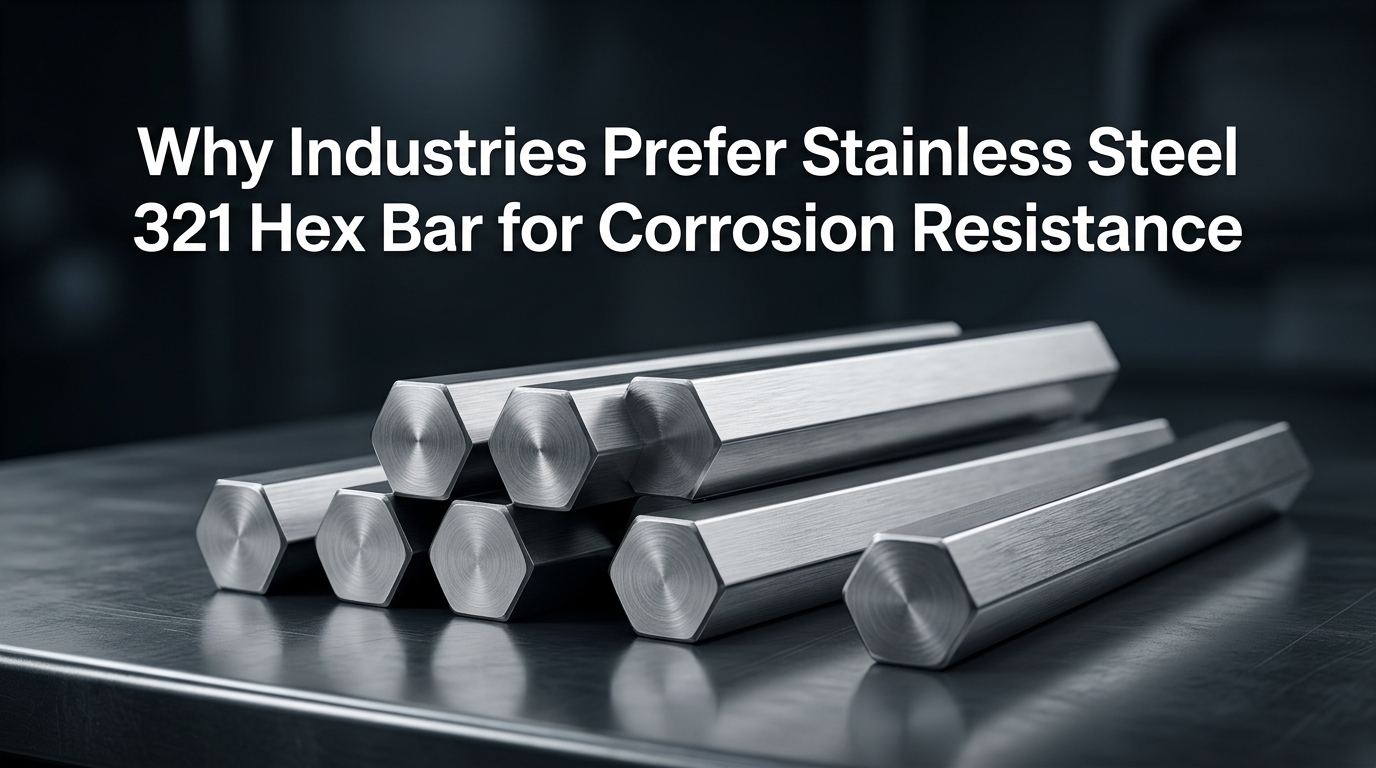
Hex bars cut from grade 321 present flat machined faces with tight flat-to-flat tolerances. That geometry suits CNC turning directly from stock. Valve bodies, coupling nuts, nozzle fittings, and threaded fasteners come off the hex bar with less material removal and shorter cycle times than equivalent profiles cut from round bar. For high-volume corrosion-critical components, that distinction matters at the production planning stage.
Corrosion Resistance Properties of Stainless Steel 321 Hex Bars
1. Resistance to High-Temperature Oxidation
Grade 321 stainless steel can operate continuously up to 900°C and briefly up to 925°C. At these temperatures, chromium moves to the surface and forms a protective oxide layer that blocks oxygen. Unlike 304, 321’s titanium carbides stay stable across the sensitisation range, preventing chromium loss at grain boundaries. This leads to longer maintenance intervals, reduced unplanned replacements and lower long-term costs in thermally cycled assemblies compared to SS 304.
2. Improved Resistance in Corrosive Operating Conditions
Intergranular corrosion attacks sensitised steel along its grain boundaries, where acids target chromium-depleted zones and break the structure apart in ways standard inspections often miss. Grade 321 blocks this failure mode through its microstructure. In chloride-containing streams at ambient temperature, it behaves much like 304. Neither grade tolerates prolonged exposure to hot, concentrated hydrochloric acid, but in most industrial services, 321 delivers reliable performance over 20–30 years.
3. Long-Term Structural Reliability
Mechanical and corrosion performance are linked. Annealed grade 321 has a minimum tensile strength of 515 MPa and a yield strength of 205 MPa. These values stay stable through repeated heating and cooling because its stabilised microstructure prevents grain boundary embrittlement. As a result, maintenance intervals lengthen, unplanned replacements decline, and long-term costs drop compared with 304 in thermally cycled assemblies.
Why Industries Choose Stainless Steel Hex Bars for Critical Applications
Hex stock removes a fabrication step. A machinist producing threaded couplings, sensor bosses, or flange blanks from hex bar starts with the geometry already established. Round bar demands preliminary profiling before precision turning begins. Per-piece cycle times on the hex bar is 15–25% shorter for these component types, and material yield improves proportionally. For grade 321 specifically, the alloy’s weldability without mandatory post-weld heat treatment adds another operational advantage. Fabricated assemblies go from welding to service without the annealing cycle that unstabilised grades require to restore corrosion resistance in the heat-affected zone.
Major Industries Using Stainless Steel 321 Hex Bar
Aerospace uses 321 hex bars in exhaust rings, firewall fasteners, and nacelle hardware that run above 600°C for thousands of flights, where failure is unacceptable. Chemical plants choose it for reactor nozzles and shafts exposed to acids at 400–700°C. Power plants use it in superheater supports and steam fittings that heat and cool every day. Heat exchanger makers specify it for plugs and fittings under high pressure with corrosive fluids. Automotive exhaust systems use it for studs and sensor bosses facing hot gas and road salt. Fabricators adopt 321 for welded structures above 400°C instead of managing post-weld annealing on 304.
Stainless Steel 321 Hex Bar vs Conventional Stainless Grades
Grade 304 is more affordable and suitable for ambient and low temperature service, but in welded assemblies, which are normally in the sensitisation range, it becomes susceptible to intergranular corrosion. Grade 316 improves chloride resistance with added molybdenum but still does not have stabilisation. It is more expensive than 321 and does not solve high temperature sensitisation. Grade 321 is also available in a niobium-stabilised form (347) but is not as widely stocked. SS 21 is preferred as it can tolerate the sensitisation temperature range without post weld annealing, cutting out an extra process step and avoiding the risk of distortion.
Factors to Consider When Selecting Stainless Steel Hex Bar Suppliers
Flat-to-flat dimensional accuracy determines whether hex bar feeds CNC equipment without constant setup correction. Ensure tolerances conform to EN 10278 or ASTM A484 as applicable to the country of installation. Mill test certificates must carry heat numbers traceable to the specific delivered bars, not generic batch documentation. Certifications to PED 2014/68/EU, NACE MR0175, or equivalent standards are a sign that a supplier adheres to documented process controls throughout the entire production chain, particularly relevant for regulated industries.
Skytech Rolling manufactures and supplies 321 stainless steel hex bars with full heat traceability and third-party inspection availability, which is the kind of documentation chain that simplifies compliance sign-off in aerospace and pressure vessel fabrication. Beyond certification, size range availability separates suppliers with genuine stocking depth from those holding only the high-runner sizes. If a supplier has a 6 mm to 100 mm flat-to-flat range in stock, it can save significant time on projects. Check to see if you can get both annealed and drawn-and-stress-relieved conditions, because precision-machined components often need tighter tolerances than standard hot-finished profiles can provide, and drawn bars can do the job.
Conclusion
Not every application needs grade 321. But when a welded assembly will hold temperature between 425°C and 850°C in service, and when that assembly contacts acidic or oxidising media, the grade earns its specification. Titanium stabilisation plays one specific role. It prevents the chromium depletion that turns a corrosion-resistant alloy into a liability at operating temperature. That is why aerospace, chemical processing, and power generation operations keep preferring it. Sourcing 321 hex bars through qualified stainless steel hex bar suppliers with proper mill certification and traceable heat documentation is the final variable that determines whether the material’s metallurgical performance translates into actual long-term service reliability.