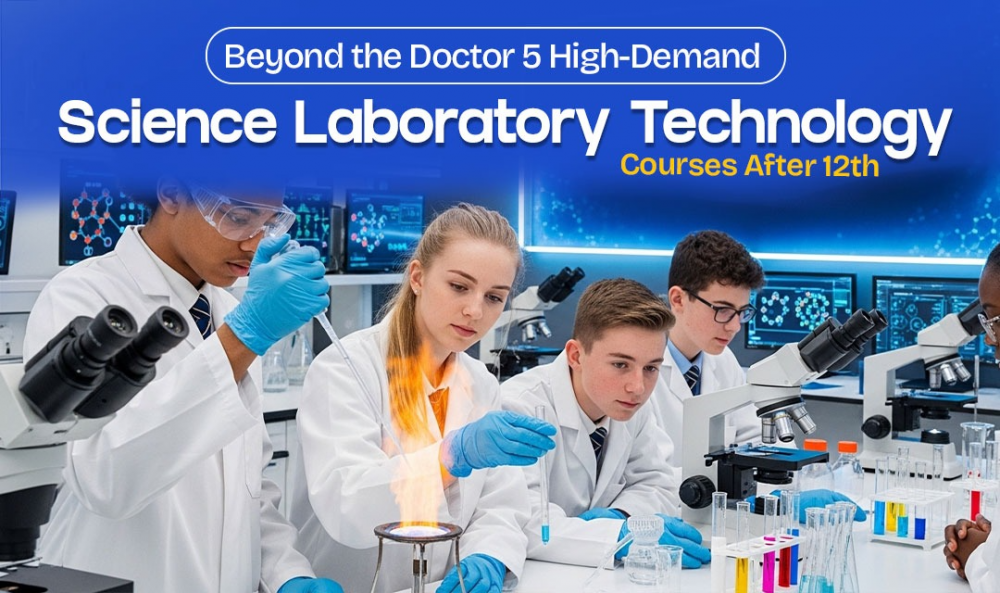
Discover 5 high-demand science laboratory technology courses after 12th. No diploma required for admission. Consequently, start your career quickly in hospitals or research labs.
Did you not know that the healthcare diagnostics market is projected to increase by 20% each year within the next five years? As per the latest figures provided by the industry reports, there will be a requirement of over 2.5lac new laboratory technicians by the year 2027. Equally, a 2024 survey of the healthcare workforce showed that 72 percent of diagnostic labs indicated that they had trouble getting qualified technicians. This means that there are many good career opportunities other than the conventional medical degrees to science students.
A lot of students consider that the only respectable career in science is becoming a doctor. But this is a totally false premise. The courses in laboratory technology provide stable jobs, high wages and career advancement. Hence, this guide will discuss five popular high-demand post-12th science courses. Laboratory technicians are always assured of employment, as there is a high demand.
Major Points Covered:
- Short waiting times and a high rate of employment upon the completion of the Science laboratory technology courses.
- Hands-on training facility available using contemporary methods and equipment for diagnosis.
- Various workplace opportunities are available after Science laboratory technology courses, such as hospitals, research laboratories and pharmaceutical firms.
- Science laboratory technology courses offer good career advancement between technician and supervisor/lab manager.
- Specialisation possibilities in such disciplines as microbiology or haematology.
- No diploma to be admitted to the majority of lab tech programs.
Why Science Laboratory Technology Courses are Excellent Alternatives for Science Students
Bernice Raymond, a department head of the course writing service at The Academic Papers UK, describes in her latest study that the career of a respectable scientist is not limited to medicine. She claimed that laboratory technology is an excellent option besides the medical profession.
This professional role is both stable and well-paying. As a result, financial security is absolutely achievable. Consequently, students can explore several different choices. Each path suits unique preferences and strengths. Therefore, you can find a perfect match for your personality.
Moreover, it is crucial to study a major that fits your goals. It must align with your personal objectives as well. Otherwise, you might face dissatisfaction or burnout later. Thus, careful selection from the start is vital. Additionally, wise choices mark the beginning of success. They represent the first step in a scientific decision. Ultimately, your future career depends on these actions. So, take the time to research thoroughly.
5 High-Demand Science Laboratory Technology Courses
This field offers specialised training for booming sectors like healthcare and biotechnology. Programs range from Medical Laboratory Technology, where you learn to produce cutting-edge therapies, to Medical Laboratory Technology, which prepares you for diagnostic roles in hospitals. Other high-demand paths include Biotechnology, Forensic Science, and Medical Research, all offering strong job growth and hands-on lab work
1. Diploma in Medical Laboratory Technology (DMLT)
This is a two-year DMLT program that is oriented toward practical skills training in diagnostic skills. Students acquire the skills of gathering and examining a sample of a patient. As a result, graduates are employed in hospitals and diagnostic centres at once. There are two to three lakh per year starting salary.
Why DMLT Offers Quick Career Entry
The DMLT course program only has a duration of two years to complete. As such, students are able to get into the workforce in a very short time compared to degree holders. This fast-track entry is attractive to those who require fast jobs. On-the-job training will train you on how to work in a real laboratory. You thus begin earning as others continue with their studies.
Key Benefits:
- Two years enables quicker career commencement.
- Direct job placement on completion of the course.
- No long college education needed.
- Employers highly appreciated the practical skills.
- Low-cost course fees for the students.
What You Learn During the Program
They include biochemistry, microbiology and haematology in the curriculum. Laboratory management and the fundamentals of blood banking are studied by the students. Real-world training constitutes a significant component of everyday learning. Graduates are hence career-ready right after graduation. Practice is encouraged by the theory.
2. BSc in Medical Laboratory Technology (BSc MLT)
This three or four-year degree provides intensive laboratory training. Biochemistry, microbiology and clinical pathology are well covered in the curriculum. Thus, graduates can always have better career advancement opportunities. The freshers make between two-and-a-half and four lakhs annually. The absence of a diploma means that admission is not a complicated matter.
Why Choose BSc MLT over Diploma Programs
Graduates receive better payments than diploma graduates regularly. Promotions to supervisor positions in careers occur more quickly with degrees. Thus, the overall long-term earning potential will be considerably improved.
What the Complete Curriculum Includes
In the first year, one courses anatomy, physiology and fundamentals of biochemistry. In the second year, clinical pathology and haematology are discussed in detail. Third-year majors in immunology and advanced molecular biology. The success highly depends upon how to write a winning coursework.
How Career Prospects Look After Graduation
Medical laboratory technologists are largely employed in hospitals and testing centres. The position of lab supervisor is open and available after two years of experience. Pharmaceutical companies regularly hold positions as research assistants.
3. BSc in Medical Radiologic and Imaging Technology (BMRIT)
There is a very acute shortage of radiology professionals in the UK. There are approximately twenty thousand radiologists who work with more than a billion and four hundred million people. This ratio is therefore way below international healthcare standards. This scarcity brings about mammoth demand for imaging technicians. The BMRIT program is aimed at equipping students to bridge this gap.
Why BMRIT Offers Excellent Career Prospects
The four-year course trains students to work on X-ray and MRI machines. The CT scanners and ultrasound equipment are also discussed in detail. Thus, graduates are critical participants of diagnostic teams all over. Skilled imaging technologists are always urgently required in hospitals. The employment stability in this sector is unusually high at all times.
| Position | Average Starting Salary (UK) | Experience Level |
| Radiology Technician | £22,000 – £28,000 | Fresher / Entry Level |
| CT Scan Operator | £25,000 – £32,000 | 1–2 Years |
| MRI Technologist | £30,000 – £38,000 | 2–4 Years |
| Senior Imaging Specialist | £40,000 – £48,000 | 5+ Years |
| Department Supervisor | £45,000 – £55,000 | 7+ Years |
What You Learn During This Program
Radiography and human anatomy are widely studied by students. Radiation physics and radiation safety are fully addressed. Practical training occurs in the radiology departments of the hospital regularly. Thus, graduates are totally ready to work in real clinics. Theory and practice are mixed throughout the curriculum.
4. BSc in Forensic Science
It is an interesting discipline that incorporates biology and the principles of criminal investigation. The students analyse physical evidence and assist in solving crimes. Thus, the BLS stated that employment is expected to grow at a rate of eighteen percent. Graduates do jobs at government laboratories and police departments. As an area of specialisation, forensic science is a good career choice.
Why Forensic Science Attracts Students
The subject matter of crime investigation can lure most young science students in a natural way. The careers in forensic science have gained popularity through television shows. This is why the yearly interest in this sphere increases steadily. Real-life forensics is also thrilling and satisfying. You serve justice and society in a meaningful way.
What You Study in Forensic Science
The DNA analysis and toxicology are extensively covered in the curriculum. Ballistics and the examination of trace evidence are taught in detail. Methods of crime scene investigation are a significant part at all times. Students are taken through mock crime scenes regularly. As a result of this, the training begins in the first year itself.
How Career Opportunities Look After Graduation
Positions of crime lab analysts are in governmental forensic laboratories all around the country. CSI practitioners are in direct contact with police departments regularly. The forensic scientists analysed DNA and toxicology samples professionally. Private investigation agencies also employed qualified graduates for this purpose.
5. Life Sciences Technician (Non-Medical)
This is a program that would fit students who are interested in research and not in healthcare. Technicians assist in research in the environmental and agricultural fields. As a result, they operate in drug manufacturing firms and research centres. MDPI indicates that wages are between 12000and 30000 dollars a month. Time can only translate into a much higher income.
Key Work Settings for Life Sciences Technicians
Technicians are used in research institutes regularly. The pharmaceutical firms require assistance in drug development. There is a constant need among environmental agencies to assist them with pollution testing. Crops and soil samples are researched in agricultural research stations.
The laboratories that provide quality control are in charge of making products safe. In the table, you find the scope of these courses, which were designed with the help of the top coursework writing services in the UK experts:
| Experience Level | Monthly Salary Range (£) | Annual Salary Range (£) | Typical Job Roles Available |
| Entry Level (0–2 Years) | £1,800 – £2,300 | £22,000 – £28,000 | Laboratory Assistant, Junior Lab Technician |
| Mid Level (3–5 Years) | £2,300 – £3,000 | £28,000 – £36,000 | Senior Laboratory Technician, Laboratory Supervisor |
| Experienced (5–8 Years) | £3,000 – £3,700 | £36,000 – £45,000 | Research Technician, Technical Officer |
| Advanced (8+ Years) | £3,700 – £4,500 | £45,000 – £54,000 | Laboratory Manager, Research Coordinator |
| Specialist Roles | £4,800+ | £58,000+ | Quality Control Manager, Senior Research Scientist |
Conclusion
Courses in laboratory technology provide superior career opportunities to conventional medical degrees. The high development rate of the healthcare sector guarantees the demand for qualified technicians. Therefore, students are not limited in the choice of their options based on their interests and abilities. In terms of patient interaction, research or investigative role, have your preferences.
DMLT and BSc MLT are appropriate for people who are interested in diagnostic healthcare. BMRIT attracts students who are interested in imaging technology. Forensic science is the perfect blend of science and investigating crimes. Do not forget that pragmatic knowledge is more important in such professions than theoretical knowledge.
To this end, select programs with good practical training and an internship. The first step to becoming a laboratory professional is the appropriate course choice. Are you now prepared to pursue these exciting career opportunities? Look into research colleges, eligibility for checking, and apply early. The profession of a doctor is not the only way for your future in science.
Frequently Asked Questions about Science Laboratory Technology Courses
1. Can I join laboratory technology courses without a diploma?
Yes, absolutely. Any course in laboratory technology does not require a diploma. The admission is based on your 12th-grade science marks. Other institutes can administer their own entrance exams. Nonetheless, a diploma applies to medical degree programs only. Thus, students who do not obtain a diploma have the opportunity to apply.
2. What is the difference between DMLT and BSc MLT?
DMLT is a diploma program and lasts two years, but is based on core skills only. BSc MLT is a three- to four-year degree with wider coverage. Degree holders are better paid and progress in their careers at a faster rate. Nevertheless, the two qualifications give an instant employment opportunity. The decision will be based on what you want as a career and what time you have. Therefore, they should conduct research on their two options first before making a decision.