Look, data privacy wasn’t always this complicated.
A few years ago you could slap a cookie notice on your website and call it a day. Nobody really checked. Regulators were still figuring out what they even wanted. Users didn’t think twice about clicking “accept all.”
That world is gone.
India’s DPDP Act is in full effect. GDPR enforcement has teeth. States across the US have their own rules now. And users — real people — have started actually reading what they’re agreeing to. Wild, right?
So if your organization collects personal data and you’re still winging the consent piece, this article is for you. We looked at five platforms that are genuinely helping businesses handle this properly. Not just technically compliant, but actually built for how consent management works in the real world.
First — what does “consent management software” actually mean?
It’s less complicated than it sounds.
At its core, it’s software that handles the paper trail around user consent. Did this person agree to receive marketing emails? When did they agree? Did they ever change their mind? If they ask you to delete everything tomorrow, can you actually do that cleanly?
That’s what these platforms manage. The collection, the storage, the changes, the withdrawals, and — crucially — the proof. Because in a regulatory audit, “we think users consented” doesn’t cut it anymore. You need records.
Some platforms keep it simple. Others go deep into privacy governance territory. We’ve got both types on this list.
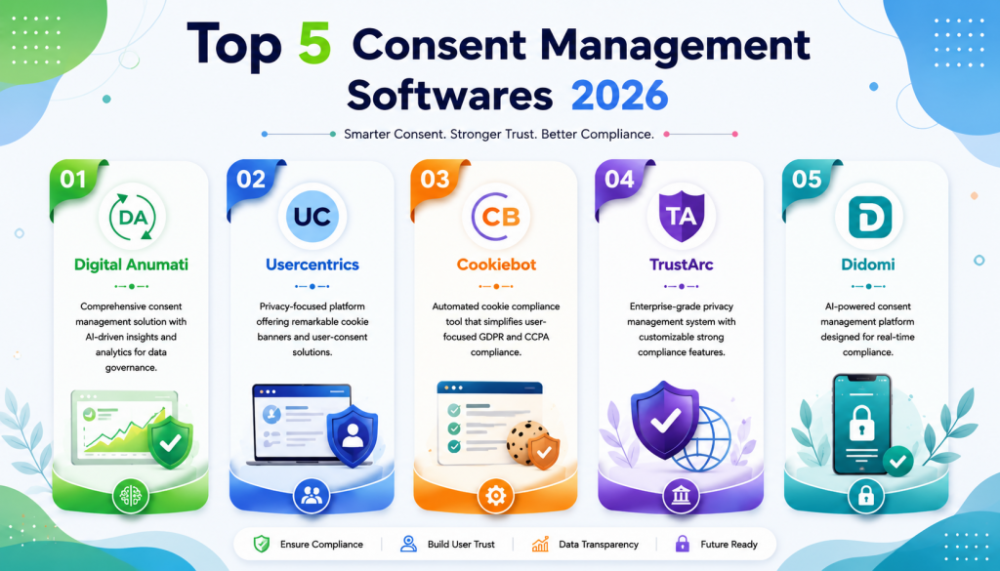
The 5 platforms worth knowing about
1. Digital Anumati
Full disclosure — Digital Anumati is the most comprehensive Consent Management Software on this list. It’s also the one most purpose-built for organizations that need consent management to actually work under pressure, not just look good in a demo.
Here’s what I mean. Most tools handle the moment of consent well enough. User clicks accept, system logs it, done. But what happens six months later when that user wants to know exactly what they agreed to? Or when they want to change three specific preferences but not others? Or when your legal team needs to pull records for a specific user cohort before a hearing?
That’s where a lot of platforms fall apart. Digital Anumati was built with those scenarios in mind from the beginning.
The consent repository is centralized — no records scattered across three different systems that don’t talk to each other. The audit reports are actually readable by humans, not just technically exportable. And the withdrawal management doesn’t feel like an afterthought that got built in a weekend.
It’s also genuinely strong on the integration side. If you’ve ever dealt with a compliance tool that technically has an API but practically requires a six-month implementation project — this isn’t that.
What’s included:
- Consent lifecycle management (full, not partial)
- Preference management portal users can actually navigate
- Centralized consent repository
- Real-time tracking
- Withdrawal management that works cleanly
- Audit reports built for real regulatory scrutiny
- API integrations
- Multi-language support
- Enterprise security
- Customer rights management
Works well for: Healthcare, fintech, insurance, education, SaaS, e-commerce, enterprise. Basically any organization where the stakes around consent are genuinely high.
2. Usercentrics
Usercentrics is solid. That’s not a backhanded compliment — reliability actually matters a lot in compliance software.
It covers the fundamentals well, works across websites and apps without creating integration headaches, and has decent multi-language support if you’re operating in multiple markets. The compliance reporting is clean enough to be useful.
It’s not trying to be the most innovative platform on the market. It’s trying to be the one that just works. For a lot of businesses, that’s exactly what they need.
Core capabilities: Consent collection, preference management, multi-language support, compliance reporting, website and app integrations.
Good fit for: Businesses running across multiple digital channels who need consistent, reliable consent handling.
3. Cookiebot
Cookiebot has carved out a specific niche and it owns that niche well.
The pitch is simple: let us automate the cookie compliance process so you don’t have to think about it. Scans your site, categorizes everything, generates the banner, keeps the documentation current. For small teams without anyone dedicated to privacy, that automation is a genuine lifesaver.
It’s not built for complex enterprise consent governance. It was never trying to be. But for what it does — keeping small and mid-sized businesses cookie-compliant without draining resources — it works.
Core capabilities: Automated cookie scanning, consent banner management, documentation, compliance monitoring, basic reporting.
Good fit for: SMBs that need solid cookie compliance handled cleanly and affordably.
4. TrustArc
TrustArc is where you end up when “consent management” isn’t actually the whole problem — when you need full privacy governance infrastructure.
Data mapping, risk assessments, compliance monitoring across multiple jurisdictions, privacy impact assessments. It’s a platform, not a tool. That means more setup, more cost, and considerably more capability.
For a multinational with regulatory exposure across several regions and a dedicated privacy team — it makes sense. For a 50-person startup — probably overkill.
Core capabilities: Consent governance, privacy assessments, compliance monitoring, data mapping, risk management.
Good fit for: Large enterprises with genuinely complex, multi-jurisdictional compliance needs.
5. Didomi
If your product lives on mobile, Didomi deserves serious attention.
The SDK integration is genuinely well-built — it doesn’t feel like someone ported a web experience onto mobile and called it done. The preference centers are polished. User rights management works in a way that feels native to app experiences.
For digital-first companies where mobile is the primary touchpoint, it’s probably the strongest option on this list for that specific context.
Core capabilities: Consent collection, preference centers, mobile SDK, user rights management, compliance dashboard.
Good fit for: Digital-first businesses and organizations where mobile is the core channel.
How to actually choose between these
Nobody can tell you which platform is right for your organization without knowing your situation. But here’s what actually matters when you’re evaluating:
What regulations apply to you specifically. Not all platforms support all frameworks equally. Don’t assume — verify that the platform covers your actual compliance obligations.
How messy your current tech stack is. Integration friction is a real cost. If a platform technically supports your CRM but practically requires rebuilding three workflows to make it work, factor that in.
How much you’re going to grow. Consent volumes scale with users. Make sure the platform you pick today can handle where you’ll be in three years without doubling in cost.
Whether the audit reports are actually useful. This sounds boring but it matters enormously. “Technically exportable” and “useful in a real audit” are very different things.
What the user experience is like. Consent flows that are confusing, buried, or deliberately difficult to navigate don’t just annoy users — they attract regulatory attention. Simple and honest is the standard.
Why this matters beyond compliance
Here’s the thing nobody really talks about.
Organizations that handle consent well — genuinely, not performatively — end up with better data. Users who trust you with their preferences tend to be more engaged, more willing to share relevant information, and less likely to opt out of everything just to be safe.
The compliance angle gets all the attention because the penalties are real and visible. But the trust angle is where the actual long-term value sits.
The 2026 context
Three things have shifted significantly in the last few years.
Users are more aware. Not universally, not perfectly — but meaningfully more than before. They notice when opting out is designed to be difficult. They notice when their stated preferences don’t seem to actually change anything.
Regulators are more aggressive. More enforcement actions, bigger fines, less patience for organizations that treat compliance as a checkbox exercise.
And the standard has moved. Explicit consent, clear transparency, demonstrable accountability — that’s the baseline now, not the advanced version.
Businesses adapting to that reality are building something durable. The ones still treating consent as a nuisance are accumulating risk they can’t see yet.
Wrapping up
All five platforms on this list solve real problems. The right one depends entirely on your scale, your industry, your regulatory exposure, and how seriously you need to take the audit trail.
For organizations that need consent management to hold up under real pressure — not just look compliant but actually be compliant — Digital Anumati is the one most purpose-built for that. The others have their contexts where they shine.
Pick the one that fits your actual situation. And if you’re not sure what your actual situation is — that’s a sign it’s worth spending more time on before you buy anything.
FAQs:
Q1. Do I actually need this, or is a basic cookie banner enough?
A1. Depends on your industry and jurisdiction. For most organizations collecting meaningful personal data in 2026 — a cookie banner alone isn’t enough.
Q2. What’s the difference between these platforms?
A2. Mostly scope and depth. Cookiebot handles cookie compliance. TrustArc handles enterprise privacy governance. The others sit somewhere in between with different strengths.
Q3. How long does implementation take?
A3. Varies wildly. Simple cookie compliance tools can be live in a day. Full consent lifecycle platforms for enterprise organizations can take weeks to integrate properly.
Q4. Is consent management software expensive?
A4. The range is huge. SMB-focused tools start cheap. Enterprise platforms with full governance suites are a meaningful investment. Most have tiered pricing based on traffic or users.
Q5. Will users actually notice or care?
A5. More than they used to. A consent experience that’s clear and honest gets noticed. A dark pattern that makes opting out deliberately confusing also gets noticed — just by different people, for different reasons.