Let’s be honest, data is everywhere. Every click, purchase, message, and swipe creates data. But here’s the real game-changer. It is not just about collecting data anymore; it’s about using it instantly. That’s where AI-powered analytics tools step in.
If you are planning to start a startup or run a business, understanding this is not optional anymore; it’s your edge.
Let’s break down the biggest trends simply.
Top AI Trends in Real-Time Analytics
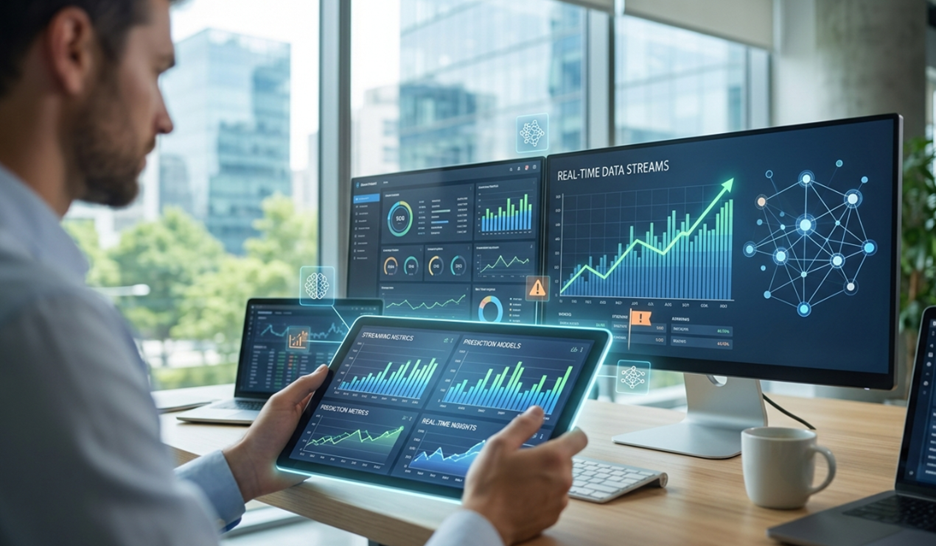
AI in real-time analytics represents a shift from analyzing historical data to interpreting information as it is generated, allowing businesses to make instant, actionable decisions. By integrating technologies like machine learning for real-time insights, natural language processing (NLP), and edge computing. AI enables businesses to move from reactive to proactive, in-the-moment operations, driving up to 40% reductions in fraud and 30% higher customer engagement.
Below, we have listed real-time data analytics trends. Let’s explore!
Instant Decision-Making
Earlier, it used to be complex to give quick responses and make quick decisions. Humans have to do lots of data research before making any final decisions. As AI enters, it helps businesses to spot customer behaviour instantly, adjust pricing in real time, and detect problems before they grow.
Key benefits:
- Faster responses
- Real-time actions
- Quick problem-solving
- Better decisions
Smarter Predictions
Traditionally, the finance sector used to predict future trends, and sometimes human predictions failed. Now, AI is adopted by many industries; it not only tells about the present situation, but it will also inform you about future trends, demands, risks, and a lot more.
Key benefits:
- Predicting customer demand
- Forecasting sales
- Identifying risks early
Automation is Taking Over Repetitive Work
We know repetitive work often feels boring, and it also reduces productivity among humans. But the good news is that AI handles that now, with real-time analytics reports generated automatically, alerts are triggered without human effort, and the system adjusts itself.
Key benefits:
- Saves time
- Less manual work
- Fewer errors
- Higher efficiency
Hyper-Personalization
Do you know the hyper-personalization market is expected to reach $30.38 billion by the end of 2026? Hyper-personalization allows the experience to personalize individuals. For example, Netflix uses a hyper-personalization method.
Key benefits:
- Better customer experience
- Targeted offers
- Higher engagement
- Increased sales
Real-Time Fraud Detection & Security
Imagine you get notified about any fake transactions to your account or any malpractices done for hacking your account. AI systems can detect unusual transactions instantly, flag suspicious activity, and prevent losses in real time. Banks and ecommerce platforms rely heavily on this to protect users.
Key benefits:
- Instant fraud alerts
- Safer transactions
- Reduced losses
- Strong security
Edge Computing
Instead of sending data far away to a big server, edge computing works closer to where the data is created (like on your device). This makes everything much faster and smoother. It helps businesses react instantly without waiting. In simple terms, it saves time and improves speed.
Key benefits:
- Faster processing
- Low delay
- Real-time response
- Better performance
AI+Human Collaboration
AI is not here to replace people; it’s here to help them. It handles heavy data and gives smart suggestions, while humans use their judgment to make final decisions. Together, they work faster and smarter. It’s like having a super-smart assistant by your side.
Key benefits:
- Better decisions together
- Improved productivity
- Smarter insights
- Reduced workload
Data Democratization
Earlier, only experts could understand data, but now everyone in a business can use it easily. With simple dashboards and visuals, even non-technical people can make decisions. This means better teamwork and smarter choices. In short, data is no longer limited to just tech teams.
Key benefits:
- Easy data access
- Simple dashboards
- Better team decisions
- No tech skills needed
Industry-Specific Applications of Real-time AI Analytics
As far as we have seen, real-time analytics involves processing and analyzing streaming data immediately as it is generated, allowing businesses to make instant and data-driven decisions. Below, we have listed all the sectors that have adopted AI into their daily operations for smooth and scalable business operations.
Healthcare
In healthcare, real-time patient monitoring systems use AI to analyze vital signs, predict potential complications, and alert medical staff before any critical situations take place. This system processes thousands of data points per second, enabling early interventions and significantly enhancing patients’ outcomes.
Retail
Retailers adjust prices in real-time based on competitor pricing, inventory levels, and demand functionalities to maximize revenue. Recommendation engines analyze browsing behaviour in real-time, delivering personalized recommendations that drive over 80% of content consumption on platforms like Netflix.
Financial
AI algorithms analyze transaction data in milliseconds, identifying unusual patterns and stopping fraudulent activity before it completes. Financial institutions use ML models to analyze market trends in real-time, executing trades instantly to maximize profitability and mitigate risk. AI systems provide instant credit decisions by evaluating real-time applicant data and alternative data sources.
E-Commerce
Real-time AI analytics in e-commerce transforms data into instant action, driving up to 59% higher sales through hyper-personalization, dynamic pricing, and optimized logistics. Key applications include AI-driven product recommendations based on live behavior, instant fraud detection, automated inventory management to prevent stockouts, and intelligent chatbots for customer service.
Final Thoughts
With artificial intelligence in business analytics and real-time data processing with AI, businesses can make faster and smarter decisions. Trends like predictive analytics trends 2026, big data, and AI integration are shaping the future. By using real-time business intelligence solutions and focusing on AI-driven decision making, companies can stay ahead and grow faster.