Commercial spaces in 2025 face a pressure older offices never had: every square foot needs to earn its keep. A conference room that sits empty 70% of the week while a training session runs out of space 2 corridors away is a layout problem, not a booking problem. Glass sliding folding partitions solve it at the architectural level, letting a single floor plate shift between 2, 3, or 4 distinct configurations in under 5 minutes. For an in-depth look at how operable partition systems perform across commercial settings, Malrox’s solid operable partition resources cover the full range of system types and specification requirements.
What Are Glass Sliding Folding Partitions?
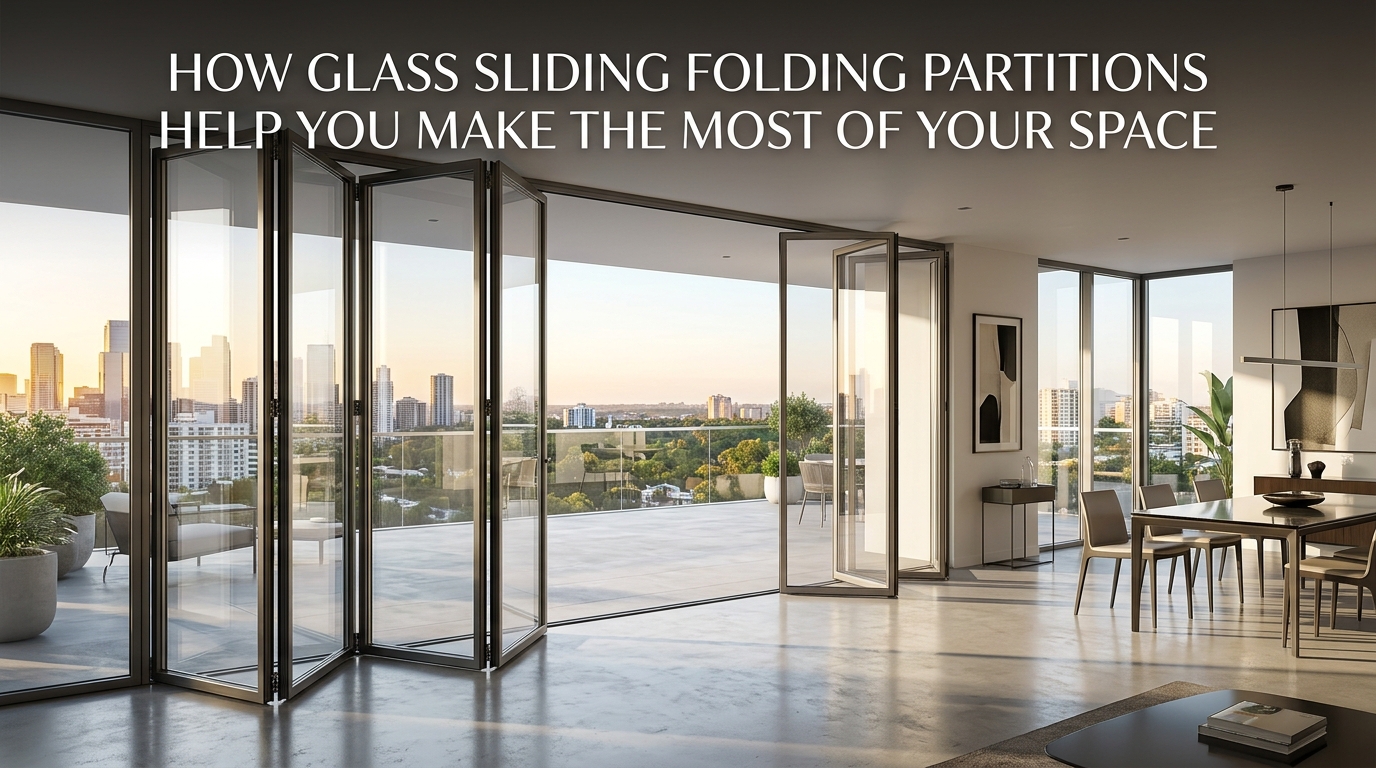
A glass sliding folding partition moves on a ceiling-mounted aluminum track, folding panel by panel into a stacked parked position at one or both ends of the opening. Each panel runs 600 to 1,200 mm wide and carries a full-height glazed face single, double, or acoustic-rated laminated glass depending on the specification. When closed, panels interlock at vertical edges and compress against floor and ceiling seals to form a self-contained room boundary. When open, they stack completely clear of the span, which can reach 20 meters or more in continuous track systems. None of the glass carries structural load, the track and panel frame carry all the weight, so the layout changes without touching the building structure.
Why Space Optimization Matters in Modern Commercial Spaces
Open-plan offices gained ground through the 2000s and 2010s, but organizations now report that uninterrupted open space creates acoustic fatigue and reduces focus work output. A 2022 Leesman workplace survey found only 57% of employees rated their workplace as effective for individual focused work. The answer isn’t returning to fixed cellular offices. Movable glass partition walls let a 200 m² floor plate operate as a single open event space in the morning and split into 4 meeting rooms by the afternoon, without moving furniture. That flexibility supports hybrid working patterns, multipurpose event programming, and the headcount changes that businesses manage every 18 to 24 months.
Key Benefits of Glass Sliding Folding Partitions
Better Space Utilization
A fixed wall takes a room permanently out of a floor’s configuration options. A sliding folding glass partition gives back every square meter to every possible use. Hotel ballrooms split a 600 m² function space into 3 independent rooms with 20 minutes’ setup. Law firms convert a 12-person boardroom into 3 private consultation rooms on short notice. Panels move on track, not floor, so there’s no threshold strip, no trip hazard, and no floor damage during reconfiguration.
Improved Natural Light and Openness
Full-height glass panels pass daylight through the full partition face. A conference room behind a closed glass partition still receives natural light from the perimeter facade an outcome impossible with a solid demountable wall. A 2018 Cornell University study found employees near windows reported 84% fewer headaches and 73% better vitality compared to counterparts in artificially lit spaces. Office space partition solutions built around glass construction let organizations meet those wellbeing benchmarks without sacrificing room enclosure.
Enhanced Privacy Without Permanent Walls
Acoustic glass partitions achieve sound reduction of 36 to 52 dB Rw depending on glass specification and frame seal design. A 10 mm laminated acoustic glass panel with perimeter compression seals reaches around Rw 38 dB sufficient for a confidential client conversation without it carrying into an adjacent open workspace. Upgrading to a double-glazed unit with a 100 mm air gap pushes that to Rw 48 to 52 dB, meeting acoustic separation requirements for financial services, healthcare, and legal office applications.
Modern Aesthetics and Professional Appearance
Floor-to-ceiling glass panels read as premium architectural finishes, not as temporary partitioning. They extend sightlines, make corridors feel wider, and create visual coherence that translates into measurable brand perception for client-facing spaces. A reception area separated from a waiting zone by a glass movable sliding wall partition communicates organizational investment in workspace quality without permanent construction.
Applications Across Different Commercial Environments
Operable partition systems allow diverse industries to dynamically optimize their floor space based on changing daily demands.
Corporate Offices
They divide spacious open collaboration areas into private meeting zones, allowing companies to easily adapt to shifting headcount needs without committing to restrictive, fixed construction layouts.
Hotels and Conference Centers
They allow hospitality managers to rapidly transition a massive general session hall into multiple intimate breakout rooms or board dinners on the same day within a single floor plate.
Educational Facilities
They divide large lecture halls into smaller, focused seminar classrooms during lower-capacity periods, then easily open up the full space for large-scale examinations and presentations.
Healthcare Clinics
They use advanced acoustic glass panels to cleanly isolate confidential consultation zones from public waiting areas, ensuring strict patient speech privacy while maintaining vital visual supervision lines.
Factors to Consider When Choosing a Partition System
Floor Supported vs Other Systems
Floor supported operable partition systems carry panel load through floor-mounted tracks rather than ceiling-hung mechanisms. This suits buildings where the ceiling structure can’t take suspended loads. The tradeoff is a floor track at the panel threshold, which requires threshold design consideration for wheelchair access compliance. Ceiling-hung systems avoid floor tracks but need a structural ceiling capable of carrying 30 to 60 kg/m of track load.
Acoustic and Functional Requirements
Target Rw values drive glass specification directly. Spaces requiring speech privacy need a minimum Rw 38 dB. Spaces handling amplified audio need Rw 45 dB minimum, which requires double-glazed panel construction. Confirm the target acoustic performance with an acoustic consultant before selecting panel specification upgrading after installation costs 3 to 5 times more than specifying correctly upfront.
Space Layout and Design Goals
Panel stack depth at the parked position ranges from 300 to 600 mm depending on panel count and width. A 6-meter opening using 900 mm panels stacks to approximately 400 mm per stack end. Map the closed, open, and intermediate configurations before finalizing system width and panel count to confirm all configurations work within the actual floor plate.
Conclusion
Glass sliding folding partitions solve the space flexibility problem that fixed walls create. They let floor plates serve multiple functions, pass natural light through room boundaries, and deliver acoustic performance matching fixed construction at the top specification levels all without permanent structural commitment. Certified operable partition system providers including Malrox, Modernfold, and Dorma Hüppe offer full specification support, acoustic testing documentation, and installation-ready systems across the full range of panel sizes and glass specifications. Specify the acoustic target first, confirm structural support capacity second, then select the panel system that fits within the parked stack depth the layout allows.