Someone asked me this last week over coffee, and I gave him the annoying answer first: it depends on what you’re building and how much you can afford to be wrong. He didn’t love that. So I gave him the real version, which is what this whole post is.
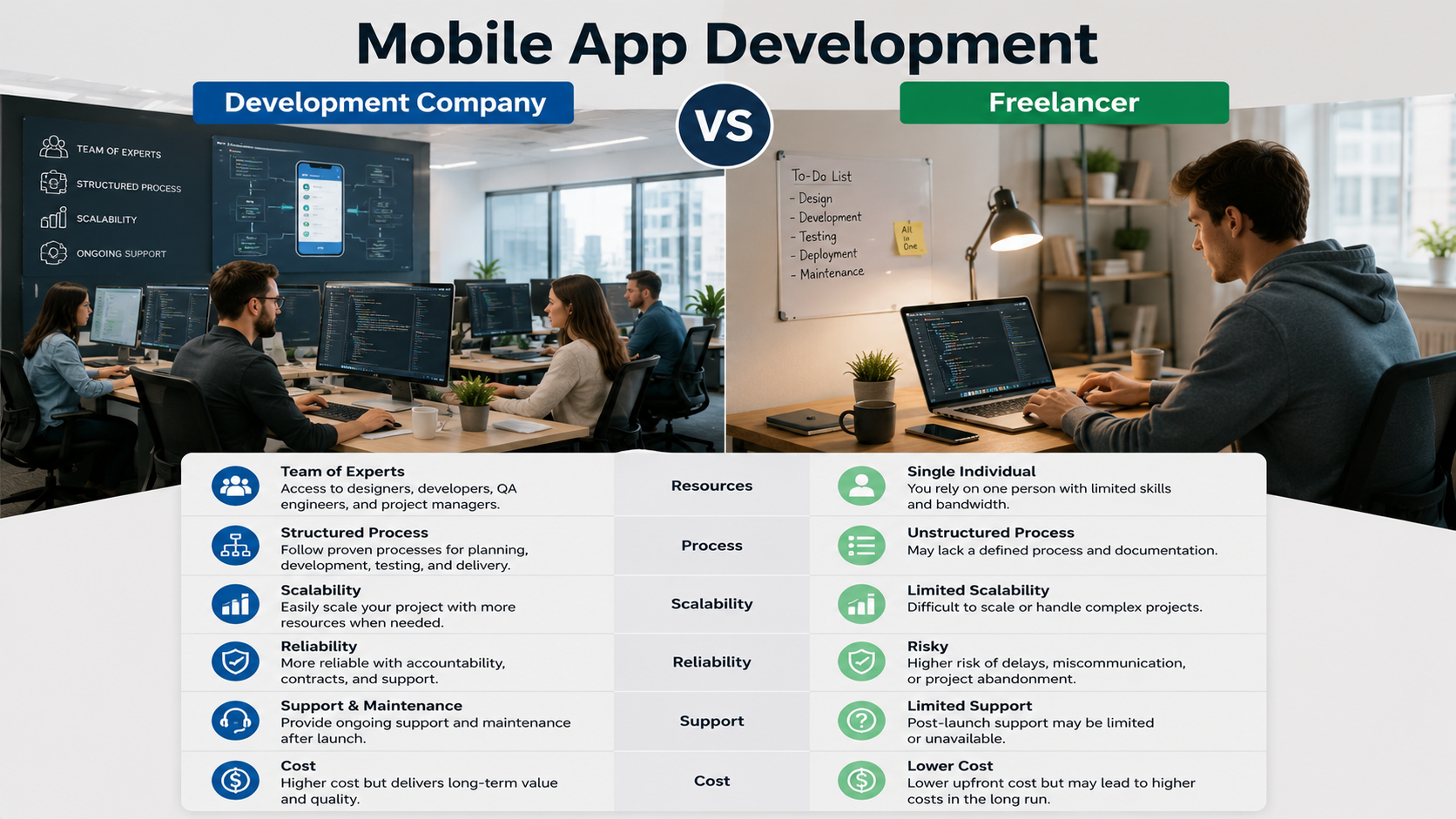
The choice between hiring an individual freelancer and hiring a Mobile App development company isn’t really about price, even though that’s where everyone starts. It’s about risk, scale, and how much hand-holding your project needs. Get the match right and you save money and stress. Get it wrong and you can torch your budget on either an agency you didn’t need or a solo dev who couldn’t carry the load.
Let me break down how they actually differ, so you can figure out which side you fall on.
The freelancer: one person, all the upside and all the risk
A freelancer is exactly what it sounds like one developer, working independently, usually billing hourly or per project.
The appeal is obvious. They’re cheaper, often a lot cheaper. You talk directly to the person writing the code, no account managers in the middle, no telephone game. For something small and well-defined a simple app, an MVP to test an idea, a specific feature added to something existing a good freelancer can be the perfect fit. Fast, lean, direct.
But here’s the catch nobody mentions in the upsell. A freelancer is a single point of failure. They get sick, they take another gig, they vanish mid-project and it happens more than you’d hope and your whole thing stalls with nobody to pick it up. One person also rarely does everything well. Great coders are often mediocre designers. Strong designers can’t always architect a backend. You’re betting your project on one skill set being broad enough, and that bet doesn’t always pay.
Quality assurance is another quiet gap. Solo devs test their own work, which is a bit like proofreading your own writing you miss things because you’re too close. No dedicated QA, no second set of eyes, more bugs slipping through to your users.
The company: a team, a process, and a price to match
An agency brings a whole crew project managers, designers, multiple developers, QA testers, sometimes specialists in security or a specific platform.
What you’re actually buying isn’t more people, it’s process and redundancy. Somebody gets sick, someone else covers. You need a designer and a backend engineer and an iOS specialist? They’re all under one roof, coordinated. There’s a project manager whose entire job is making sure things don’t fall through cracks, which sounds like overhead until you’ve lived through a project where nobody owned that.
Accountability is the underrated part. A company has a reputation to protect, contracts, a structure you can hold to account if things go sideways. A freelancer who ghosts you leaves you with very little recourse. An agency that messes up has a lot more on the line.
The obvious tradeoff: cost. You’re paying for all that infrastructure, and the price tag for an agency runs meaningfully higher than a freelancer’s rate. For a small, simple project, that overhead can be money you genuinely didn’t need to spend. For a complex, long-term, business-critical app, it’s often the smartest money you’ll spend.
So which one is actually right for you
Forget the generic “it depends” for a second. Here’s how I’d actually decide.
Lean freelancer if: your project is small or clearly scoped, you’re testing an idea with an MVP, your budget is tight, you can manage the project yourself, and a delay wouldn’t be catastrophic. A weekend-side-project-turned-real, a single new feature, a straightforward utility app freelancer territory.
Lean company if: your app is complex or will grow, it’s central to your business, you need multiple disciplines (design, multiple platforms, backend, security), you want someone else managing the process, and you need reliability you can count on. Anything where downtime costs you real money, or where the app is the business go with the team.
There’s also a middle path people forget: a small studio or a “pod” of freelancers working together. You get some of the team benefit without full agency pricing. Worth knowing it exists.
How to actually hire well, whichever way you go
Picking the category is only half of it. The bigger question of How to Hire a Mobile App Development Company? comes down to a few things that apply almost as much to vetting a freelancer.
Look at real work, not just a polished portfolio. Ask for apps actually live in the stores, ideally ones you can download and poke at. Talk to a past client if you can a quick “would you hire them again?” tells you more than any case study.
Get clear on ownership and process up front. Who owns the code and the IP when it’s done? (You should, in writing.) How do they handle scope changes, because scope always changes. What’s the communication rhythm weekly check-ins, a shared board, or radio silence until delivery? Is QA included, or is testing somehow your problem?
And pin down what happens after launch. The app shipping is the start of its life, not the end. OS updates, bug fixes, small improvements who handles those, and at what cost? A cheap build with no support plan can get expensive fast the moment something breaks.
One more, easy to forget: sign an NDA before you share the good details of your idea. Any serious freelancer or company will expect it.
The honest bottom line
There’s no universally right answer here, and anyone who tells you “always hire an agency” or “freelancers are always cheaper and just as good” is selling something.
A freelancer is a scalpel precise, affordable, perfect for the right specific job, risky if you ask it to do open-heart surgery. A company is a hospital more expensive, more overhead, but built to handle complexity and keep going when one part fails. Match the tool to the job. A startup testing a scrappy MVP and an enterprise launching a business-critical platform should not be making the same call, and the moment you frame it as scalpel-versus-hospital instead of cheap-versus-expensive, the right choice for your situation usually gets a lot clearer.
Figure out how complex your project really is, how much risk you can stomach, and how much of the management you want to own yourself. Answer those honestly and the decision mostly makes itself.