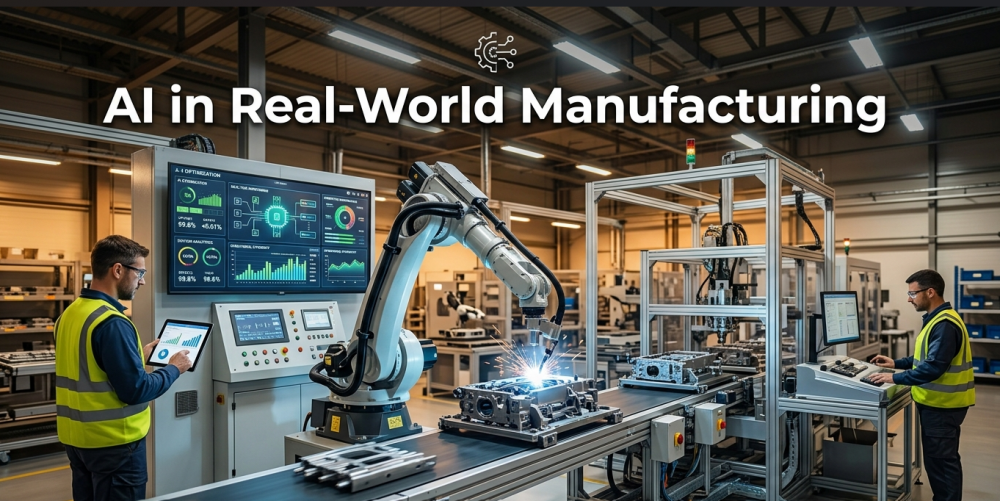
Artificial Intelligence in the Manufacturing industry is reshaping by enhancing efficiency, precision, and adaptability across various production processes, particularly in the context of Industry 4.0. AI in manufacturing industries is driving predictive maintenance, quality control, supply chain optimization, and more.
So, you must be crawling around different websites to know how AI helps factories? And what is the future of AI in manufacturing? Don’t worry, you have landed on the right page! Here, we have discussed how AI in manufacturing enhances product quality. Let’s delve!
What is actually changing or transforming?
Imagine a smart robotic assistant that handles all your work without you even having to say a word. Do all your work on time and deliver it to you before the deadlines hit. Similarly, Artificial Intelligence in Manufacturing boosts efficiency, quality, and safety by utilizing data from sensors and machines to enable predictive maintenance, automate visual inspections and optimize production workflows.
For example, a machine that tracks things like heat, speed, or vibrations. AI studies this data and can detect problems even before they occur.
Let’s move on and learn how AI-powered smart manufacturing helps the industry. Here’s a list, do explore!
Fixing Machines Before They Break
Following traditional methods for repairing systems might disrupt your system or permanently fail to function. Rather than integrating AI-driven manufacturing solutions, it can predict failures before they occur. Now AI can warn, just like “Hey, this part might fail in a few days”.
By following this manual, workers fix problems early, saving time, money, and even stress.
Better Product Quality
Humans often fail to check products; even after checking, they miss big red signs that affect them later, when they have to spend more money fixing the issue.
AI in production optimization uses cameras to quickly and carefully scan products. It can spot tiny defects that are hard to see with the naked eye. This means better quality products for customers.
Smarter Planning and Less Waste
Humans always wait until the last moment to complete work. As with modern trends, industrial automation with AI helps decide how to produce and when.
Instead of relying on guesswork, AI looks past data, trends, and demands. So factories don’t make too much or too little. This reduces waste and saves resources.
Humans are Still Important
A common fear is that AI will replace jobs. But in reality, it mostly helps people rather than replacing them. Workers no longer have to run from boring work or risky tasks. Instead, they can focus on more important work, such as managing systems or solving problems.
In modern methods, machines handle repetitive and complex tasks, while humans handle the thinking and creative part.
Saving Energy and Supporting the Environment
AI can also help factories use less electricity and raw materials. It finds ways to reduce waste and improve efficiency. So it’s not just good for business, it’s also better for the environment.
Final Thoughts
Overall, the future of manufacturing is becoming smarter and easier. With smart factory technology, machines and systems can work together smoothly without constant human effort. Machine learning in manufacturing helps factories to learn from past data and keep improving over time. With predictive maintenance powered by AI, problems can be fixed earlier, before they even happen.
AI in manufacturing reliably means less stress, fewer mistakes, and better outcomes. Now, factories are not just working harder; they are working smarter, making life easier for both businesses and people.